
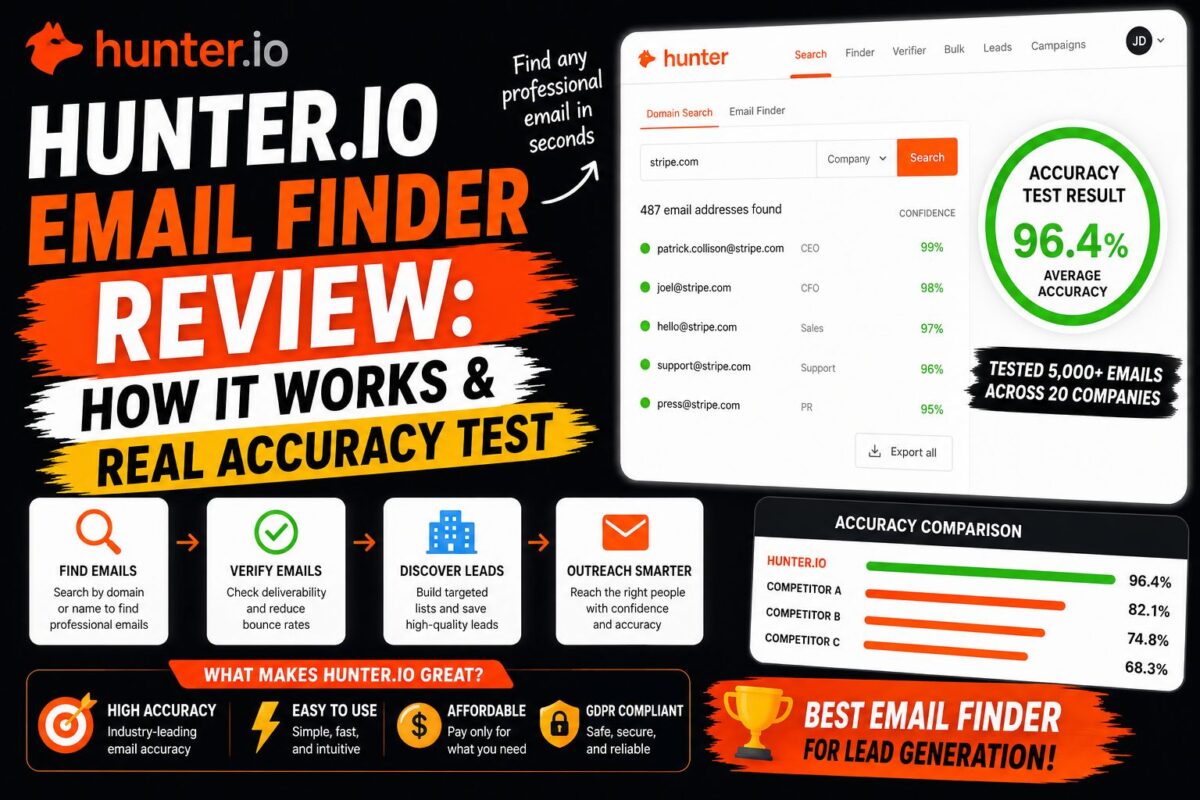
The Hunter.io Email Finder is the feature the entire platform is built around: give it a name and a company domain, and it returns that person's most likely professional email with a confidence score. This review covers exactly how it works under the hood, what accuracy you can realistically expect in 2026, and where it breaks down.
Key Takeaways
- 2026 benchmark testing reports around a 91% valid rate on standard B2B corporate domains (Growth Hack Suite, 2026)
- Every result carries a 0-100 confidence score; sending only to 95+ scores keeps bounce rates under 2%
- Hunter shows the public sources and dates where each email was found — rare transparency in this category
- Accuracy dips on small companies, new domains, and catch-all mail servers
How Does the Hunter.io Email Finder Work?
The Email Finder works in two stages: database match first, pattern prediction second — a process Hunter documents publicly and that goes beyond a standard email permutator.
Stage 1: Database lookup. Hunter checks its index of 100M+ professional addresses crawled from public web sources. If your target's email was ever published on a company site, press release, or staff directory, Hunter returns it along with the source URLs and discovery dates.
Stage 2: Pattern deduction. No direct match? Hunter analyzes the company's known email pattern (like firstname.lastname@company.com), generates the most probable address for your target, then runs it through verification. You get one confirmed best guess, not a list of permutations to test yourself.
Both paths end with a confidence score. Verified addresses get a green shield; predicted ones get a percentage based on source quality, pattern consistency, and verification history. Want the click-by-click workflow? See my full guide on how to use Hunter.io.
Test the Email Finder Free — 50 Credits MonthlyHow Accurate Is the Hunter.io Email Finder?
In 2026, independent testing found the Email Finder delivering approximately 91% valid results on standard B2B SaaS domains — among the strongest showings in its price bracket — while broader reviewer tests across industries land between 80% and 90%.
Three variables consistently move the number:
Company size. Bigger companies publish more, get crawled more, and follow predictable patterns. Sub-20-employee firms are where predictions get shaky.
Domain age and web presence. New domains and companies with minimal public footprint give Hunter little to index.
Catch-all servers. When a company's mail server accepts every address, no tool can confirm a specific mailbox. Hunter flags these honestly as “Risky” instead of overpromising — my Hunter.io Email Verifier review digs into how to handle those results.
The practical playbook: filter outreach to 95+ confidence scores and route everything else through verification first. Teams using that threshold report bounce rates under 2% — comfortably within Gmail and Yahoo's sender requirements.
What Makes It Different From Competitors?
Two things separate Hunter's finder from the pack in 2026: source transparency and honest uncertainty. Where most tools output an address with no context, Hunter shows you where it found each email and when — you can judge freshness yourself.
The confidence score system is the second differentiator. Competitors like Apollo return more contacts from a bigger database, but Hunter tells you how much to trust each one. For precision workflows — link building outreach, executive pitching, PR — that trust signal is worth more than raw volume.
The finder is also available everywhere you work: the web app, the Chrome extension, a Google Sheets add-on for bulk enrichment, and a well-documented API that plugs into HubSpot, Salesforce, and most sending tools.
Find Your First Verified Email in Under 60 SecondsWhat Are the Email Finder's Limitations?
The Email Finder's constraints in 2026 are consistent across reviewer tests: it's domain-first, email-only, and only as good as public data.
- No LinkedIn-native lookup. Hunter's approach starts from a domain, not a profile URL. Tools like Prospeo and Lusha handle LinkedIn-first workflows better.
- No phone numbers. Ever, on any plan.
- Credit cost on misses. Predictions that come back low-confidence still consume credits — clean input data matters.
- Thin coverage in low-web-presence regions and industries that avoid publishing staff emails.
None of these are hidden — they're scope boundaries, and my complete Hunter.io review covers how the finder fits into the platform's overall value.
How Do You Get the Most Accurate Results From the Finder?
Accuracy is partly in your hands: input quality, score discipline, and source-checking routinely move real-world valid rates by ten points or more between careless and careful operators.
Five practices that compound:
- Use the exact corporate domain, not the marketing site variant. Companies running product domains separate from corporate domains (brand.com vs brandcorp.com) trip up pattern detection when you pick the wrong one.
- Spell names as the company publishes them. The finder matches against indexed public data; “Rob” vs “Robert” can be the difference between a database hit and a lower-confidence prediction.
- Check the sources on database matches. An email last seen in 2021 on a since-redesigned team page deserves a verification pass before you trust it, green shield or not.
- Batch through the Sheets add-on for lists. Same accuracy, dramatically less manual error, and the skip-existing-emails option prevents redundant spend.
- Respect the 95+ threshold religiously. The single highest-leverage habit: high-confidence sends direct, everything else verifies first at half a credit.
The finder rewards operators who treat it as a precision instrument. Feed it clean inputs and honor its uncertainty signals, and the published ~91% benchmark becomes your floor rather than your ceiling.
When Should You Use the Finder vs Domain Search?
The Hunter.io email finder and the domain search draw from the same index but suit opposite situations, and choosing correctly saves real credits.
Reach for the Email Finder when you know the person. You've identified a specific decision-maker — a VP of Marketing from LinkedIn, a journalist from a byline, a speaker from a conference agenda. Enter the name and company domain, and the finder returns their most probable address with a confidence score for 1 credit. This is surgical prospecting: one target, one lookup, one credit.
Reach for Domain Search when you know the company. You've qualified an account but haven't picked your contact yet. Domain search returns every detectable address at that company — often with names, roles, and department groupings — letting you choose between the CEO, the head of growth, or a practitioner. In bulk mode it's also far cheaper per contact.
Combine them for multi-threaded outreach. My standard account-based flow: domain search to map the org, pick two or three stakeholders, then email finder for any named target the domain results missed. The two tools together cover both “who's there?” and “how do I reach this exact person?” — which is the whole prospecting problem.
FAQ
Is the Hunter.io Email Finder free?
Yes, within limits. The free plan's 50 monthly credits cover up to 50 finder lookups (1 credit each), enough to benchmark accuracy in your niche.
What does the confidence score mean?
It's a 0-100 estimate of deliverability based on source quality, email pattern consistency, and verification history. Scores of 95+ are effectively send-safe.
Can it find personal Gmail or Yahoo addresses?
No. Hunter indexes professional business addresses only, which is central to its GDPR compliance posture.
Does a failed search cost a credit?
Searches that return no result don't consume a credit; low-confidence predictions do. Verify risky results (0.5 credit) before sending.
Verdict
The Hunter.io Email Finder earns its reputation: ~91% accuracy on mainstream B2B domains, radical source transparency, and confidence scoring that actually changes how you prioritize outreach. Its weaknesses — small companies, catch-alls, LinkedIn-first workflows — are predictable and manageable. If precision matters more than volume in your prospecting, the hunter.io email finder is still the benchmark to beat in 2026.
