
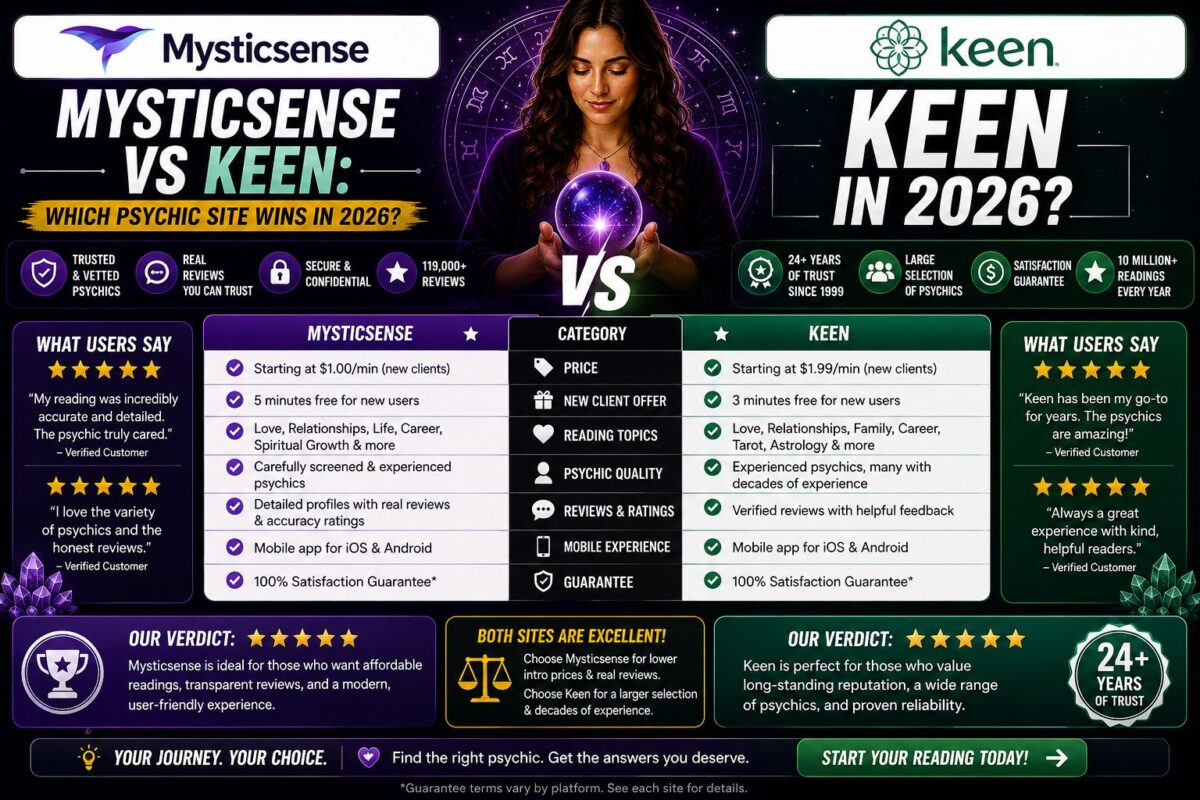
The Mysticsense vs Keen matchup is the closest call in the psychic platform space, because these two are playing the same game — big open marketplaces with per-minute billing — just from opposite starting points: Keen brings two decades of scale, Mysticsense brings modern tools and lower prices.
I've run paid sessions on Mysticsense and benchmarked Keen's structure, pricing, and intro mechanics against it. Here's the category-by-category truth, ending with a clear pick for each user type.
The 30-Second Verdict
Pick Keen if you want the deepest advisor pool in the industry and veterans whose review histories span decades. Pick Mysticsense if you want lower prices, video readings, better filtering, and a friendlier no-card entry. First-timers lean Mysticsense; review-history maximalists lean Keen.
| Category | Mysticsense | Keen | Winner |
|---|---|---|---|
| Advisor pool | Hundreds | ~3,000 | Keen |
| Starting rate | $0.99/min | $1.99/min | Mysticsense |
| Typical range | Under $5/min | $3–$10+/min | Mysticsense |
| Intro offer | 5 min credited back | 5 min for $1 | Keen (barely) |
| Card required to browse | No | Yes | Mysticsense |
| Video readings | Yes | No | Mysticsense |
| Filtering | Stack 4 filter types | Category + sort | Mysticsense |
| Track record | Since 2020 | Since 1999 | Keen |
Advisor Depth: Keen's Trump Card
Keen's roster of roughly 3,000 advisors is the largest in the niche, and longevity compounds: its top readers carry review histories in the tens of thousands, accumulated across twenty-plus years. If your vetting philosophy is “show me a decade of receipts,” Keen simply has more receipts than anyone.
Mysticsense's counter isn't size — it's navigability. A younger, smaller roster (founded 2020) means thinner histories, but the screening interview plus test reading holds the floor, and the filter system makes the pool you do have far easier to mine: stack specialty, tool, reading style, and price simultaneously, something Keen's category-and-sort browsing can't do. On Keen, finding your reader among 3,000 is your job; on Mysticsense, the filters do most of it.
Pricing: Advantage Mysticsense, and It Widens Over Time
Both platforms start advisors at accessible rates, but the distributions differ. Mysticsense's floor is $0.99/min with the bulk of the roster under $5/min and a ceiling near $10.99. Keen starts at $1.99/min, but its demand dynamics push established readers well past $10/min — the veterans you came to Keen for are precisely the ones charging veteran prices.
That's the structural catch: Keen's advantage (deep review histories) and Keen's cost (premium veteran rates) are the same advisors. You can use Keen cheaply, but only by choosing its newer readers — at which point you've given up the depth advantage you switched for.
Compare Live Rates on Mysticsense — No Card to BrowseIntro Offers: A Photo Finish
- Keen: 5 minutes for $1 — nearly free, and the simplest deal in the industry. But your card goes on file first.
- Mysticsense: deposit $10+, and your first 5 minutes come back as account credit (capped $10–$15). Slightly more money up front, but no card is required until you choose to deposit, and the $10 stays yours to spend.
Pure trial economics favor Keen by a few dollars. Friction economics favor Mysticsense: you can fully research advisors, watch video intros, and read reviews before any payment info exists. For cautious first-timers, that ordering matters more than the dollar difference.
Session Formats: The Video Gap
Mysticsense runs phone, chat, and video; Keen offers phone and chat only. If seeing your reader matters to you, this category isn't close — video is a Mysticsense exclusive in this matchup. Keen's partial counter is maturity: its phone and chat infrastructure is decades-polished, and its mobile app is more established than Mysticsense's young one.
One shared caution transfers across both platforms: prepaid mechanics (Mysticsense's video booking holds, Keen's card-on-file model) are where billing complaints concentrate industry-wide. Real-time phone and chat billing is the clean lane on both.
Trust and Complaint Profiles
Both are legitimate, established operations, and honestly their complaint shapes rhyme: praise for individual advisors alongside recurring gripes about refund friction and the occasional vague session. Keen's satisfaction guarantee caps compensation as site credit; Mysticsense reviews refund requests case by case within 48 hours and leans toward credit too. Neither will hand cash back smoothly — pick on product, not on refund fantasy, and deposit small on either.
Where the profiles diverge: Keen's quarter-century of survival is itself a trust signal Mysticsense can't match yet, while Mysticsense's pre-payment transparency (full browsing, rates displayed, no card) is a structural honesty Keen doesn't offer.
Mobile and Apps
Keen's mobile app is the mature one — years of iteration, a large review base, and stable session handling. Mysticsense's app is younger (10,000+ downloads, still building its rating history) but carries the platform's full filter system and adds online-status notifications for favorited advisors. Practically: heavy mobile users get a smoother ride on Keen today, while Mysticsense's mobile web experience is strong enough that its app gap rarely decides the matchup.
Who Each Platform Quietly Fails
Comparison posts usually skip this, so for balance: Keen fails bargain hunters — its cheapest readers are its least-proven, which defeats the reason you'd choose Keen. Mysticsense fails prestige seekers — if you want a reader whose name circulates in psychic forums with a 20-year following, the young roster can't manufacture that history. Neither failure is fixable by the platform; they're structural consequences of scale versus youth. Match yourself to the failure you can live with.
See Which Advisors Match Your Filters in Two MinutesThe Decision Framework
- First reading ever? Mysticsense — no-card browsing, $10 all-in with the credit, filters that prevent choice paralysis.
- Want a reader with 20,000 reviews? Keen — nobody else has that inventory.
- Building a regular habit? Mysticsense — the under-$5 norm compounds in your favor.
- Need video? Mysticsense by default.
- Loyal to a specific famous advisor? They're probably on Keen — follow the reader, not the platform.
If your real hesitation is trust-brand prestige rather than pool depth, the more instructive matchup is my Mysticsense vs Psychic Source comparison — that's the heritage-versus-budget question in its purest form.
FAQ
Is Keen better than Mysticsense?
For advisor pool depth and veteran review histories, yes. For pricing, filtering, video, and first-timer friendliness, no. The right answer depends on which of those you're optimizing.
Which is cheaper, Keen or Mysticsense?
Mysticsense on standing rates — a lower floor ($0.99 vs $1.99/min) and a roster concentrated under $5/min, while Keen's popular veterans commonly exceed $10/min.
Does Keen have video readings?
No — phone and chat only. Video is one of Mysticsense's clearest structural advantages in this matchup.
Can I try both cheaply?
Yes, and you should: Keen's 5-minutes-for-$1 plus Mysticsense's credited first session together cost about $11 for two real audition readings. Run both, keep the platform whose reader you preferred.
Which platform is better for love readings?
Keen's veteran love readers carry the longer track records; Mysticsense counters with situation-specific sub-filters (affairs, toxic relationships, new love) and sustainable repeat-session pricing. One-off big question: Keen. Ongoing support: Mysticsense.
Bottom Line
This is depth versus design. Keen is the sprawling veteran marketplace where the best readers have the longest paper trails and the prices to match; Mysticsense is the modern discounter with sharper tools, video, and a kinder on-ramp. My overall evaluation of the budget side — including where it falls short — is in my full Mysticsense review.
If you're still torn on Mysticsense vs Keen, run the $11 double audition above — two real sessions will settle in twenty minutes what no comparison table can.
Start Your Half of the Double Audition — 5 Minutes Credited