
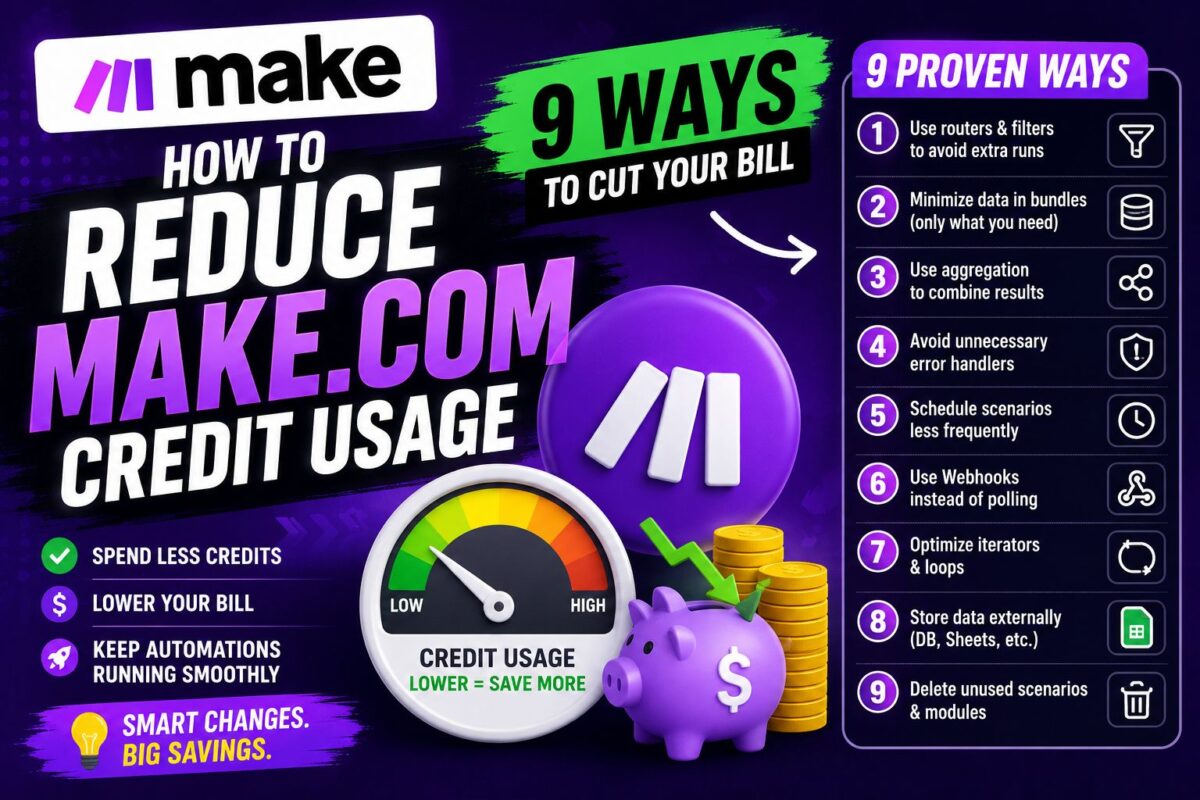
Before you upgrade plans or buy add-on packs, try this: most accounts can reduce Make.com operations (now called credits) by 30-50% through configuration changes alone — no deleted workflows, no lost functionality. The waste hides in predictable places: polling frequency, filter placement, and loops, in that order.
Here are the nine fixes, ordered by impact, plus the 10-minute audit that shows you exactly where your credits go.
Key Takeaways
- Slowing one polling trigger from 1-minute to 15-minute intervals cuts its cost 15x — the single biggest lever on most accounts
- Your top 3 scenarios usually account for 60-80% of total consumption — audit those monthly, ignore the rest
- Add-on packs carry a ~25% markup since late 2025 — chronic pack-buying means either optimize or upgrade tiers, never keep buying packs
- Iterators multiply silently: 20 items × 5 modules = 100 credits for one “run”
First: The 10-Minute Audit
Open your usage dashboard and sort scenarios by credit consumption. In nearly every account, the top 3 scenarios burn 60-80% of everything — those are your only optimization targets. (Pro plan's full-text log search makes tracing waste trivial, but the basic dashboard suffices for this.)
For each top scenario, answer three questions: How often does it trigger? How many modules run per execution? How many executions actually did something versus checked and found nothing? The fixes below map directly onto those answers.
Fix 1: Slow Down Your Polling Triggers (Biggest Win)
A trigger polling every minute makes ~43,200 checks per month — each one a credit — even when nothing new exists. Moving that same trigger to 15-minute intervals cuts trigger cost 15x, from ~43,000 credits to ~2,900.
Ask honestly per scenario: does this need minute-level speed? Reporting, filing, syncing, digests — almost never. Reserve fast intervals for genuinely time-sensitive flows (lead alerts, payment failures).
Fix 2: Replace Polling With Webhooks (Better Win)
Better than slow polling: no polling. A webhook trigger costs credits only when something actually happens — the sending app pushes the event to Make instantly. You get 1-minute-beating speed and near-zero idle cost.
Check whether your trigger app supports webhooks (Shopify, Stripe, Typeform, most modern SaaS do). This one change frequently halves an account's total consumption.
Fix 3: Filter at the Front, Not the Middle
Filters cost a credit per evaluation — but everything downstream of a filter costs nothing when the filter rejects. A filter placed immediately after the trigger kills junk records before they touch expensive modules. The same filter placed four modules deep pays for those four modules on every junk record first.
Audit rule: every scenario's second position should be its most aggressive filter.
Fix 4: Tame Your Iterators
The silent multiplier: iterating 20 items through 5 modules = 100 credits for one scenario “run.” Fixes, in order of preference:
- Aggregate instead of iterate where possible — process the batch as one bundle
- Filter before the iterator — loop only items that need processing
- Cap batch sizes — process 10 per run on a schedule rather than 200 at once
Fix 5: Merge Scenario Chains
Two scenarios where one would do means two triggers billing separately. If Scenario B only ever runs because of Scenario A's output, merge them — one trigger, one chain, fewer total modules.
Fix 6: Batch Your Scheduled Work
Five separate daily-digest scenarios with five triggers cost more than one scenario with a router fanning to five outputs. Consolidate schedule-triggered work into shared scenarios where logic allows.
Fix 7: Watch the Expensive Module Types
Not all modules cost one credit: Make Code modules (JavaScript/Python) bill at 2 credits per second of execution, and data transfer caps at ~5 GB per 10,000 credits. Long-running code and file-heavy flows deserve their own audit line.
Fix 8: Kill Zombie Scenarios
Scenarios that run, find nothing, and log success forever — old projects, abandoned tests, duplicate monitors. The audit surfaces them: anything with high trigger counts and near-zero action executions gets deactivated. Deactivated scenarios cost nothing and lose nothing.
Fix 9: Right-Size Instead of Pack-Buying
Since November 2025, add-on credit packs cost ~25% more per credit than plan-included allocations (a 10k pack runs ~$9-11). The rule: buying packs once is fine; buying packs three months running means you should either apply fixes 1-8 or upgrade your credit tier — packs are structurally the worst price. Full tier math in our Make.com pricing guide.
What This Looks Like in Practice
When we ran this exact audit on our own account: one 5-minute polling trigger converted to a webhook (-4,100 credits/month), front-loaded filters on two lead scenarios (-800), and one zombie monitor deactivated (-350). Total: ~40% reduction, zero functionality lost, 45 minutes of work. That pushed our Core plan from strained to comfortable — the difference between upgrading and not.
If you're still on free and fighting the ceiling, pair these fixes with the survival math in our free plan limits breakdown.
Optimized and still growing? Core's 10,000 credits start around $9/monthBonus Fix: Set Alerts Before You Need Them
The cheapest credit is the one you notice before it's spent a thousand siblings. Make's usage alerts (organization settings) can notify you at consumption thresholds — set them at 50% and 80% of your allowance on day one. The 50% alert arriving mid-month is your early-warning system; arriving on day six, it's a fire alarm pointing directly at whichever scenario the audit will find.
Pair the alerts with a calendar reminder for the monthly top-3 audit and credit management becomes a ten-minute ritual instead of an invoice surprise.
Optimize on the house — every fix here works on Make's free 1,000 creditsFAQ
How do I see which scenarios use the most credits? The usage dashboard sorts scenarios by consumption. Your top 3 typically account for 60-80% of the total — start there.
Do filters really cost credits? Yes, one per evaluation — but they save credits by blocking everything downstream. Early placement is what makes them net-positive.
Should I buy add-on packs or upgrade? Occasional spike → pack. Consistent overage → upgrade tiers; packs carry a ~25% per-credit markup and are the worst sustained price.
Will these fixes slow down my automations? Webhook swaps (Fix 2) make things faster. Interval slowdowns (Fix 1) only affect scenarios you've judged non-urgent — that judgment is the whole optimization.
Run the audit, apply the top three fixes, and you'll reduce Make.com operations enough to change your plan math entirely — most accounts are one webhook swap and two filter moves away from a 40% smaller bill. For whether the platform deserves that optimized bill at all, our hands-on Make.com review makes the 90-day case.
