
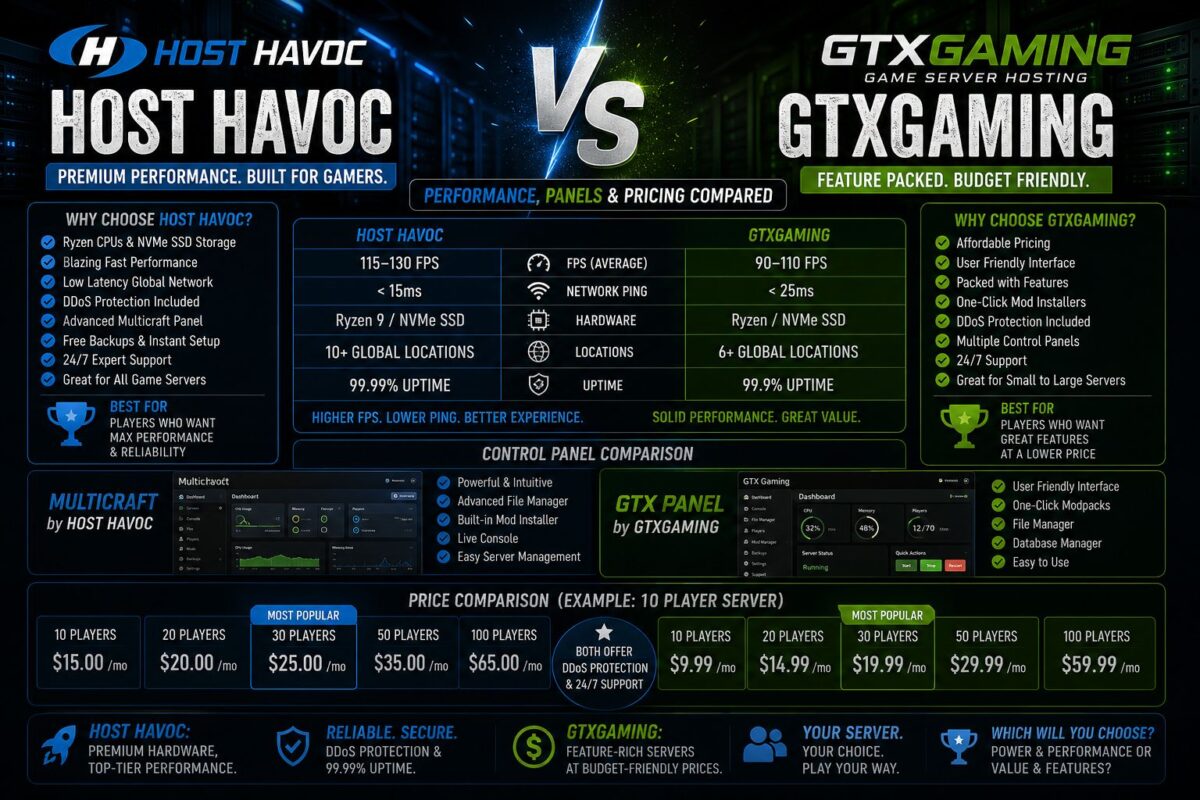
Host Havoc vs GTX Gaming is a transatlantic matchup with a clean fault line: Host Havoc is the North American premium play — owned Ryzen hardware, no budget tier, support measured in minutes — while GTXGaming is the UK-based mid-market generalist, offering 100+ games from about $4.49/month with the strongest European coverage in this weight class.
They're also each other's genuine competitors: traffic analysis ranks GTXGaming the 4th most similar site to hosthavoc.com worldwide. Here's where each one actually wins.
Key Takeaways
- GTXGaming: 100+ games from ~$4.49/mo, excellent UK/EU-West latency, Source-engine specialties (CS2 128-tick, FastDL) — rated 8.1/10 by independent reviewers
- Host Havoc: owned Ryzen 5950X/7950X + NVMe fleet, 4.8/5 across 1,500+ Trustpilot reviews, terabit DDoS included, sub-10-minute tickets
- Both panels are dated (TCAdmin lineage) — this category is a wash
- Geography often decides it: EU-centric communities lean GTX; NA and Oceania lean Host Havoc
Host Havoc vs GTXGaming: The Positioning Gap
GTXGaming built its business on breadth-per-pound: a 100+ game catalog that catches niche titles the big hosts skip, datacenters across Europe (EU-West and EU-Central), North America, and limited Asia, one-click mod installers, and mid-range pricing “usually within a few dollars of budget hosts” — the value thesis independent reviewers credit in its 8.1/10 rating. Its quiet specialty is the Source engine: CS2 at 128-tick, TF2 with SourceMod pre-configured, and FastDL bundled into most plans. Note that pricing is listed in GBP, so dollar costs float with exchange rates.
Host Havoc concentrates its 60+ game catalog on the survival core and runs it on company-owned AMD Ryzen 5950X/7950X processors with NVMe arrays — never oversold, protected by terabit-scale DDoS mitigation (3,000+ attacks handled since 2013), and backed by the ticket desk whose sub-10-minute response pattern dominates 1,500+ Trustpilot reviews.
Mid-market breadth versus premium depth. Both legitimate — for different communities.
Which Has Better Performance?
Host Havoc, on hardware — with a geographic asterisk.
The raw silicon comparison favors Host Havoc clearly: current-gen Ryzen with 5.0 GHz single-core boost and published stress-test receipts (20.0 TPS at 40+ Minecraft players with 50+ plugins) against GTXGaming's solid but unspectacular mid-market fleet. For CPU-punishing survival servers — modded ARK, high-pop Rust — analysts place both among the survival/high-load capable hosts, but Host Havoc's owned fleet delivers the more consistent floor.
The asterisk is latency, and it's a big one: for UK and Western European players, GTXGaming's local nodes beat any hardware advantage. A budget-tier US-hosted server adds 80–120ms for a London player; a GTX UK node brings that to single digits. Host Havoc counters with four EU datacenters of its own (London, Amsterdam, Frankfurt, Nuremberg), so this isn't a forfeit — but GTX's EU-West/EU-Central density is its home turf, and for PvP-sensitive games the difference is visible in gameplay.
Flip the map and it reverses: GTXGaming has no Oceania coverage at all, while Host Havoc runs Sydney. Australian and New Zealand communities have no real choice here.
Check Host Havoc's 13+ locations — including Sydney and Singapore →Pricing: Mid-Market vs Premium
GTXGaming wins the entry price, starting around $4.49/month with allocations reviewers describe as “slightly more generous than raw budget hosts” — the classic mid-market deal: more than the $2.50 tier delivers, less than the premium tier costs.
Host Havoc's structure is premium by design — roughly $5/GB for Minecraft and per-slot with unlimited storage elsewhere (Rust ~$0.53/slot) — but the effective gap narrows with the automatic 12% annual discount and recurring 10% codes (verified list in our host havoc coupon code roundup). The unlimited-storage clause is worth real money for save-heavy survival games, where GTX-class metered plans can accumulate surcharges.
One structural note for budgeters: GTX's GBP pricing means USD costs drift with exchange rates; Host Havoc's pricing is stable in USD/CAD terms. Full model-by-model math is in our host havoc pricing breakdown.
Panels and Support: One Wash, One Blowout
Panels: a wash. Both run TCAdmin-lineage panels that reviewers independently describe with the same word — “dated.” GTXGaming's custom panel covers console, file manager, RCON, and scheduled restarts; Host Havoc's modified TCAdmin v2 (plus Multicraft for Minecraft) covers the same ground with off-disk automated backups. Neither will impress anyone arriving from Nodecraft. Functional parity.
Support: a blowout for Host Havoc. GTXGaming's recurring community feedback is that response times vary by timezone — fast during UK business hours, stretching overnight for North America and early morning for Asia. Host Havoc staffs 24/7/365 to a response standard measured in minutes regardless of clock, and that consistency is the single most-cited reason for its 4.8/5 record. For admins whose emergencies don't schedule themselves around London office hours, this is the decisive category.
Get 24/7 sub-10-minute support — start with Host Havoc →Which Should You Choose?
Choose GTXGaming if: your player base is UK/EU-centric (latency is king); you need a niche game from the 100+ long tail that Host Havoc doesn't carry; you run Source-engine servers (CS2 128-tick, TF2 with FastDL); or you want a meaningful hardware step above budget hosts without paying full premium rates.
Choose Host Havoc if: your community is North American or Oceanian; you run demanding survival servers where the Ryzen fleet's consistency pays for itself; you're DDoS-exposed (PvP, public, high-profile); or you refuse to gamble on timezone-dependent support. The complete scoring is in our full host havoc review.
Weighing other rivals? The budget end of this decision tree is the host havoc vs shockbyte matchup, and the premium Minecraft-specialist end is host havoc vs apex hosting.
Price your server on Host Havoc's premium fleet →FAQ
Is GTXGaming cheaper than Host Havoc? At entry level, yes — from ~$4.49/month versus Host Havoc's premium structure. At equivalent performance tiers the gap narrows, and Host Havoc's unlimited storage plus stackable discounts close much of the remainder for survival games.
Which is better for European players? GTXGaming's UK and EU-West/Central density gives it the latency edge for British and Western European communities. Host Havoc's London, Amsterdam, Frankfurt, and Nuremberg nodes keep it competitive for continental groups.
Does GTXGaming serve Australia and New Zealand? No — Oceania is GTXGaming's acknowledged coverage gap. Host Havoc's Sydney datacenter makes it the default winner for ANZ communities in this matchup.
Which host supports more games? GTXGaming, at 100+ titles versus Host Havoc's 60+. The long tail catches niche games; Host Havoc concentrates its catalog on the survival genre where its hardware advantage matters most.
Verdict
Host Havoc vs GTXGaming splits cleanly along geography and ambition: GTX is the smart mid-market pick for EU-based communities and niche-game hunters — real value, honest 8.1/10 quality, home-turf latency — while Host Havoc is the premium choice everywhere the map or the workload favors it: North America, Oceania, demanding survival servers, and any community that's learned what timezone-variable support costs at 3 a.m.
Put your players on a map and name your game — the Host Havoc vs GTX Gaming decision resolves itself from there.
