
Hunter.io pricing looks simple on the surface — five tiers, one credit pool — but the real cost of running it depends on how you spend credits, not which plan you pick. This guide breaks down every plan, the per-email math, and the hidden costs most reviews skip.
Key Takeaways
- Plans run from Free (50 credits/mo) to Scale at $299/mo (25,000 credits), with a flat ~30% discount on annual billing (Hunter.io, 2026)
- Every plan includes unlimited team seats on one shared credit pool — you pay for usage, not people
- Real cost per found email ranges from about $0.008 on Scale annual to $0.10 with overages
- Hidden costs: extra connected email accounts from $10/month each and credit top-up packs priced above in-plan rates
What Are Hunter.io's Plans in 2026?
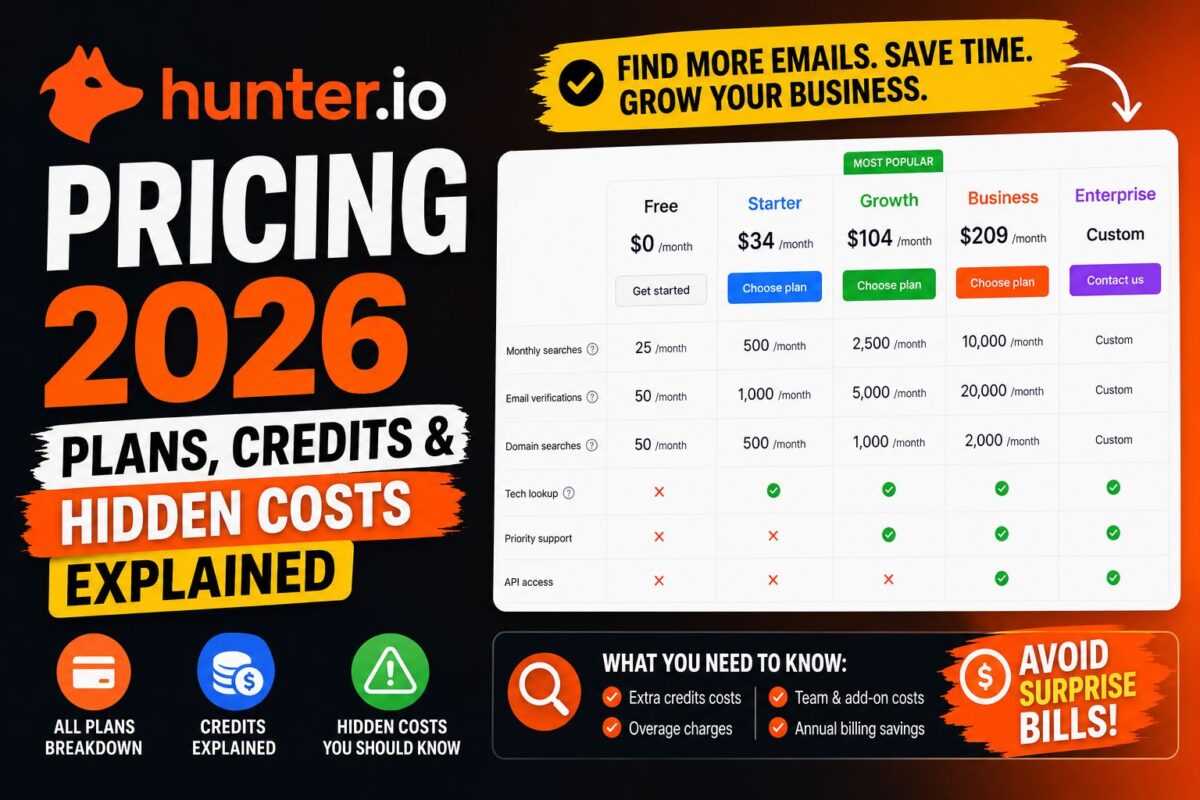
As of 2026, Hunter.io offers five plans: Free, Starter ($49/mo), Growth ($149/mo), Scale ($299/mo), and custom Enterprise, with annual billing cutting roughly 30% off each paid tier (Hunter.io pricing page, verified July 2026).
| Plan | Monthly | Annual (effective/mo) | Credits per month |
|---|---|---|---|
| Free | $0 | $0 | 50 |
| Starter | $49 | $34 | 2,000 |
| Growth | $149 | $104 | 5,000 |
| Scale | $299 | $209 | 25,000 |
| Enterprise | Custom | Custom | Custom |
Two structural points define the whole model. First, there are no per-seat fees anywhere — invite your entire team and everyone draws from the same pool. Second, credits are unified: 1 credit finds an email, 0.5 credit verifies one, and a bulk domain search costs one credit per batch of up to ten returned emails.
If the credit mechanics are new to you, my full guide on how Hunter.io credits work covers consumption rules and waste-prevention tactics in detail.
How Much Does Hunter.io Cost Per Email?
On 2026 unit economics, Hunter.io's cost per found email runs from roughly $0.0245 on Starter monthly ($49 ÷ 2,000 credits) down to about $0.0084 on Scale annual ($209 ÷ 25,000) — a 66% drop from the entry tier to high-volume annual billing.
That spread means the same workload can cost three times more depending on plan fit. A few practical benchmarks:
- Solo link builder (300-500 finds/month): Starter annual at $34/mo is comfortable
- Small sales team (1,500-2,500 finds/month): Growth annual at $104/mo
- Agency or outbound-heavy team (10,000+ finds/month): Scale annual at $209/mo delivers the lowest per-email cost
Verification is half price — 0.5 credit per check — so a find-then-verify workflow costs about 1.5 credits per confirmed contact. Budget accordingly: 2,000 Starter credits translate to roughly 1,300 fully verified contacts, not 2,000.
What Hidden Costs Should You Watch For?
Beyond the base subscription, three cost factors inflate real-world Hunter.io bills in 2026: extra connected email accounts (from $10/month each), credit top-up packs priced above in-plan rates, and preventable credit waste on bulk operations.
Connected accounts. Each plan includes a set number of sending accounts for Campaigns (one on Free, three on Starter). Additional inboxes cost from $10/month apiece — a real line item if you rotate senders.
Overage and top-ups. Running out mid-month means buying credit packs at rates higher than your plan's effective per-credit price. Chronic top-ups are a signal to move up a tier; annual Growth often beats monthly Starter plus packs.
Credit waste. Bulk domain searches on large companies can return dozens of contacts you don't need, and re-running unclean lists burns credits on rows that were never going to match. Clean your data before upload.
Try Hunter.io Free First — Test Accuracy Before You PayIs Hunter.io Expensive Compared to Alternatives?
Hunter.io sits in the mid-premium band for email finders in 2026: cheaper than enterprise data platforms, but pricier per contact than budget challengers — Snov.io starts around $39/month and Apollo bundles 30,000 annual credits plus a full sales platform at $49/month.
The honest framing: you're paying for accuracy, source transparency, and unlimited seats, not raw credit volume. Teams that value clean data and simple tooling rarely regret the premium. Teams optimizing purely for cost per contact usually find cheaper options — I compare them all in my best Hunter.io alternatives roundup.
Not sure you need a paid tier at all? Start with my breakdown of the Hunter.io free plan — for low-volume users, 50 monthly credits go further than you'd think.
Which Hunter.io Plan Should You Actually Choose?
The right tier follows directly from your monthly verified-contact volume — and 2026's per-credit economics make the decision tree short: under ~1,300 verified contacts monthly fits Starter, up to ~3,300 fits Growth, and anything beyond belongs on Scale annual.
Work backward from output, not credits. Since a found-and-verified contact costs ~1.5 credits:
- Starter (2,000 credits) → ~1,300 verified contacts/month. Right for solo operators, link builders, and freelancers.
- Growth (5,000 credits) → ~3,300 verified contacts/month. Right for small sales teams running consistent outbound.
- Scale (25,000 credits) → ~16,600 verified contacts/month at the lowest per-unit cost in the lineup. Right for agencies and high-volume teams.
Then apply the two universal rules. Always bill annually — the ~30% discount is unconditional and turns Starter into $34/month. And upgrade one tier rather than buying top-up packs twice — pack pricing above in-plan rates means two overage months typically cost more than the next tier's annual delta.
One under-appreciated scenario: seasonal volume. Because seats are unlimited and free, some teams run Starter year-round and briefly step up to Growth for campaign-heavy quarters, then back down. Hunter allows plan changes without seat-license gymnastics — a flexibility per-seat competitors can't match.
How Does Hunter.io Pricing Compare to Competitors?
Hunter.io pricing only makes sense in context, so here's how the tiers stack against the tools you're likely comparing.
Apollo starts at a similar $49/month, but the structures diverge sharply. Apollo prices per seat — a three-person team pays three subscriptions — while Hunter's unlimited seats on a shared credit pool means the whole team works from one plan.
Apollo's annual plans include larger credit allowances (around 30,000 export credits yearly), so heavy-volume solo users may get more raw lookups per dollar there. Small teams almost always come out ahead on Hunter.
Snov.io undercuts everyone at roughly $39/month, bundling drip campaigns and warm-up that Hunter doesn't offer at any tier. The catch is data quality: in my side-by-side testing, Snov's found emails verified at a lower valid rate, which quietly raises your true cost per usable contact.
RocketReach uses lookup-based pricing that climbs quickly at volume, but includes phone numbers Hunter can't provide. If you need phones, you're not choosing on price anyway.
The most useful math is cost per valid email. On Hunter's Growth plan ($104/month annual, 5,000 credits), assuming an ~91% valid rate on B2B domains, you land around $0.023 per usable address. On Scale ($209/month, 25,000 credits) that drops to under $0.01.
Cheaper tools with lower valid rates often converge on the same real cost once you account for wasted credits and the verification passes you'll run to protect deliverability.
One more pricing nuance buyers miss: extra sending accounts start at $10/month each. If you plan to run Campaigns across multiple mailboxes, factor that into the comparison — some all-in-one competitors include multi-inbox sending in the base price.
The takeaway: Hunter.io is mid-priced for the category, cheapest for small teams sharing credits, and most expensive for solo high-volume users who'd do better on Apollo's annual credit allowances.
FAQ
Does Hunter.io charge per user?
No. In 2026, every Hunter.io plan includes unlimited team members sharing one credit pool. Cost scales with credit consumption only.
Is there a Hunter.io free trial?
There's no time-boxed trial of paid tiers — instead, the permanent free plan (50 credits/month) acts as your test environment before upgrading.
What's the cheapest way to use Hunter.io?
Annual billing on the smallest plan that covers your volume. The ~30% annual discount plus correct tier fit beats monthly billing with top-up packs every time.
Do unused Hunter.io credits roll over?
Monthly credits don't roll over on the Free plan, and annual plans allocate credits as a yearly pool — check your plan's terms before assuming rollover.
Bottom Line
Hunter.io pricing rewards two behaviors: committing annually and matching your tier to real credit consumption. Do both and your cost per verified contact lands in the low single cents; do neither and you'll overpay by half.
For the full context on whether the product justifies the spend, read my complete Hunter.io review — because understanding hunter.io pricing only matters if the tool itself fits your workflow.
