
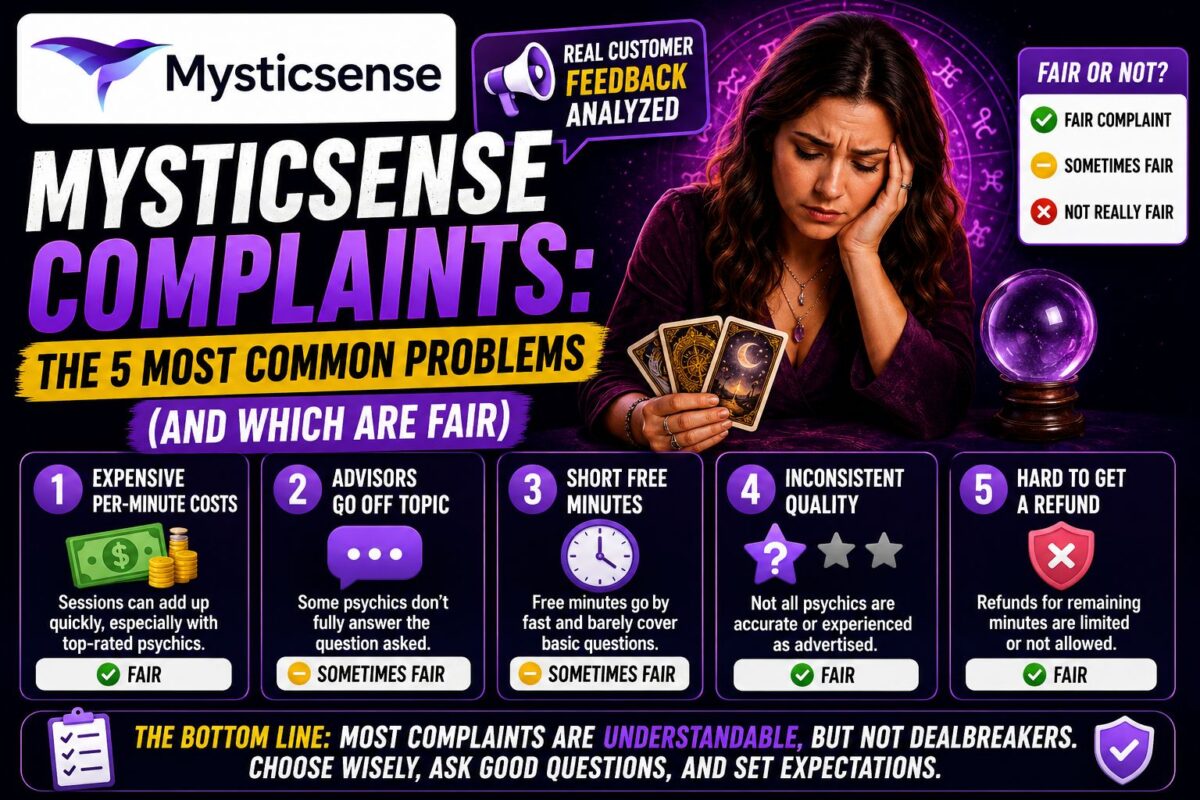
Mysticsense complaints follow a surprisingly consistent pattern once you read enough of them. I went through roughly 1,400+ Trustpilot reviews, advisor-side feedback, and app store ratings, and the same five problems account for the overwhelming majority of negative experiences.
This isn't a hit piece — I use and recommend the platform. But affiliate reviews that pretend no complaints exist are worthless, so here's the honest ranking: what people complain about, how often it's fair, and how to avoid each problem yourself.
Complaint #1: Refunds Issued as Credit, Not Cash
Frequency: the most common serious complaint. Fairness: largely fair.
The satisfaction guarantee lets you request a refund within 48 hours of a session — but requests are reviewed case by case, and approved refunds frequently land as account credit rather than money back to your card. Users who wanted out of the platform entirely find this genuinely frustrating, and I think the criticism is fair: the marketing implies more reversibility than the process delivers.
How to protect yourself: deposit in small increments ($10–$25), file any dispute inside the 48-hour window with specifics about what went wrong, and treat deposits as committed spend. The full mechanics — what gets approved and what doesn't — are in my breakdown of the Mysticsense refund guarantee.
Complaint #2: Video Session Holds That Don't Release Cleanly
Frequency: recurring. Fairness: fair.
Booked video sessions place a prepaid hold for the scheduled length. The documented pattern: users cancel in advance, expect the hold released to their card, and instead find it converted to account credit — in one well-documented case, a $65 hold. The money isn't stolen, but the conversion-without-consent pattern is the platform's worst billing behavior and deserves the criticism it gets.
How to protect yourself: start with phone or chat sessions, which bill in real time with no holds. Only book video once you already trust a specific advisor and intend to keep the session.
Complaint #3: Vague or Generic Readings
Frequency: common. Fairness: partially fair — and partially the nature of the product.
Some users describe sessions that felt like horoscope-grade generalities delivered at per-minute prices. Two honest things are true at once here. First, reading quality genuinely varies by advisor — a marketplace with hundreds of readers has a bottom quartile, and Mysticsense's younger roster means thinner review histories to vet against. Second, no platform can guarantee a reading resonates; these are subjective experiences, and disappointment sometimes reflects mismatched expectations rather than a bad advisor.
How to protect yourself: require 100+ reviews with a 4.5+ average before booking, read the written reviews for specificity (not just stars), and filter for a “direct” reading style if vagueness is your fear. My guide to psychic accuracy on Mysticsense covers exactly how the screening works and how to read rating signals.
Browse Advisors With 100+ Verified ReviewsComplaint #4: Inconsistent Customer Support
Frequency: moderate. Fairness: mixed.
Support experiences split sharply: plenty of reviews describe fast, kind resolutions, while others report slow replies or unhelpful form responses — especially on billing disputes. The company does respond publicly to most negative Trustpilot reviews, which is a better pattern than silence, but response quality clearly varies by issue type. Simple questions get resolved; contested money questions drag.
How to protect yourself: use email (support@mysticsense.com) with dates, session details, and screenshots in the first message. Vague complaints get vague responses; documented ones move faster.
Complaint #5: Advisor-Side Complaints About Pay and Call Volume
Frequency: visible on Glassdoor. Fairness: fair for advisors — but a mild positive signal for customers.
Working psychics complain about sporadic call volume, long unpaid waiting hours, and refund chargebacks landing on the advisor. That's a genuine workplace grievance. From a customer standpoint, though, it cuts the other way: readers absorb consequences from bad reviews and refunds, which pressures session quality upward, and the oversupply of available advisors is why prices stay at $0.99–$10.99/min instead of Kasamba's $8–$15 norm.
What People Don't Complain About (Notable Silences)
Just as informative is what's missing from the complaint record. Across everything I read, I found essentially no pattern of: hidden recurring charges, identity or payment-data misuse, in-session upsell scripts (“curse removal” scams), or fake advisor profiles. The complaints concentrate on billing edge cases and subjective session quality — not on the fraud patterns that define actual scam platforms.
For context, this complaint shape is normal for the niche: Keen's Trustpilot profile shows the same mix of advisor praise and prediction-disappointment, and Kasamba's premium pricing generates its own cost complaints. Mysticsense's distinctive weakness is specifically the refund-to-credit pattern; its distinctive strength is that price complaints — the most common gripe against rivals — barely appear, because there's not much to complain about at $0.99–$5/min.
That distinction is the core of my verdict on whether Mysticsense is legit: legitimate operation, imperfect refund culture.
The Complaint-Proof Playbook
- Deposit small — $10–$25 at a time. Nothing about the platform rewards big balances.
- Phone or chat first — no prepaid holds, real-time billing only.
- Vet with the 100+/4.5+ rule — review volume plus average, then read three written reviews.
- Set a session budget out loud — “I have 15 minutes today” keeps per-minute billing honest.
- Dispute within 48 hours, in writing, with specifics — and expect credit, not cash.
Follow those five and you've neutralized every complaint category on this list except subjective reading quality — which no checklist can fully solve on any platform.
Try a Low-Risk First Session — 5 Minutes Credited BackFAQ
Is Mysticsense a scam based on the complaints?
No. The complaint profile is billing friction and variable session quality — not fraud. Scam platforms show hidden charges, fake profiles, and payment misuse; none of those patterns appear here.
What's the single most common Mysticsense complaint?
Refund handling: approved refunds usually arrive as account credit rather than cash back to your payment method, and approval isn't automatic.
Does Mysticsense respond to complaints?
Yes — the company publicly replies to most Trustpilot reviews, including negative ones, and directs disputes to support@mysticsense.com.
Should the complaints stop me from trying it?
If you deposit small, start with phone or chat, and vet advisors by review volume, the realistic downside of a first session is about $10. For most people that's an acceptable test — and if the refund culture specifically is your dealbreaker, the Mysticsense alternatives with smoother guarantees are worth a look before deciding.
Bottom Line
Every psychic platform accumulates complaints; what matters is the shape of them. Here, the shape is clear: money moves into and around the platform smoothly, moves back out reluctantly, and session quality tracks the advisor you pick. All five problem patterns above are avoidable with small deposits, hold-free session formats, and disciplined advisor vetting.
For the complete picture including everything the platform gets right, my complete Mysticsense review weighs these issues against the strengths — and if you read the negatives here and still felt more informed than scared, that's the right takeaway from Mysticsense complaints.
See the Platform Behind the Reviews — No Card to Browse