
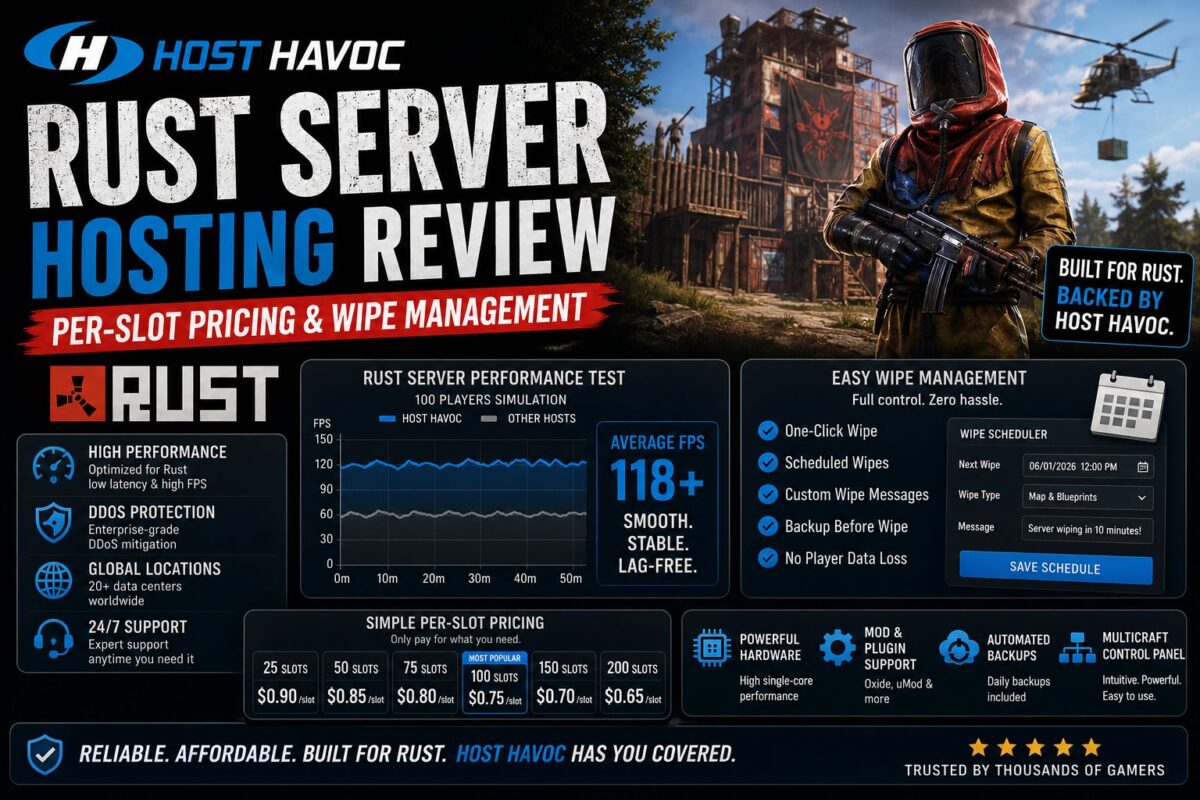
Host Havoc Rust server hosting gets judged on exactly one day a month: force wipe. When the map resets and half your player base tries to log in at the same minute, oversold hardware folds — and that's the scenario Host Havoc's whole premium model is built to survive.
The numbers: ~$0.53 per slot (a 30-slot server runs about $16/month), unlimited storage, owned Ryzen hardware, and DDoS protection included on every plan. Here's how that translates to actual Rust server ownership.
Key Takeaways
- Per-slot pricing at ~$0.53/slot with unlimited storage — a 30-slot Rust server costs roughly $16/month
- AMD Ryzen 5950X/7950X single-core speed is exactly what Rust's notoriously CPU-bound server process needs
- Included terabit-scale DDoS protection — Rust servers are among the most attacked in gaming
- Reviewers flag it as a top pick for communities where players “notice every stutter and blame the host”
How Does Host Havoc Perform for Rust?
Rust's server process is brutally single-thread-bound: entity counts, big monuments, and 100+ populations chew through CPU on one core. Host Havoc's fleet of AMD Ryzen 5950X and 7950X processors boosting to 5.0 GHz is about as good as commercially hosted Rust gets, and the NVMe SSD arrays keep map loads and saves from stalling.
Independent hosting analysts single out Host Havoc for exactly this profile — recommending it for “Rust, Conan Exiles, and DayZ operators whose players notice every stutter and blame the host.” That's the correct framing: Rust players are the least forgiving audience in survival gaming, and server reputation dies on lag clips.
Two more factors matter disproportionately for Rust:
No over-provisioning. Your allocated resources are real. Wipe-day population spikes hit dedicated headroom, not a node shared with forty other servers having their own wipe day.
Included DDoS protection. Rust attracts more DDoS attacks than nearly any other hosted game — salty raid victims with booter subscriptions are a genre cliché. Host Havoc's multi-tiered, terabit-scale mitigation (3,000+ attacks handled since 2013) is bundled free on every plan, not an upsell.
Check Rust server availability in all 13+ Host Havoc locations →How Much Does a Host Havoc Rust Server Cost?
Rust uses the per-slot model: about $0.53/slot, so common configurations look like —
30 slots ≈ $16/month — a solid small-community or modded low-pop server. 50 slots ≈ $26.50/month — mid-pop territory. 100 slots ≈ $53/month — full public server scale.
Because pricing scales linearly with no volume curve, size to your realistic peak, not your dream population — you can add slots later without rebuilding. And the unlimited storage half of the model is worth real money for Rust specifically: wipe archives, Oxide plugin data, and backup retention never appear as surcharges.
Comparative context: budget hosts undercut this per-slot rate, but typically on older shared CPUs where wipe day is a gamble; the full cross-provider math is in our host havoc pricing breakdown, and the 12% annual discount plus recurring promo codes stack on top.
What's Wipe and Mod Management Like?
Rust admin life runs through Host Havoc's modified TCAdmin v2 panel, and the toolset maps well to the monthly Rust rhythm:
Scheduled tasks handle the wipe workflow — automated restarts, scheduled map/BP wipes, and custom command sequences so force-wipe Thursday doesn't require you at a keyboard. Oxide/uMod support covers the modded ecosystem, with full FTP access for plugin configs, custom maps, and anything the one-click tooling doesn't cover. Automated backups stored off the live disk protect blueprint data and map states, with one-click restore. RCON access works with the standard Rust admin toolchain.
The panel is functional rather than modern — a fair criticism across all of Host Havoc's non-Minecraft games — but every operation a Rust admin performs monthly is one or two clicks deep. If you're new to server ownership entirely, our how to set up a host havoc server guide covers the checkout-to-first-join path.
And when something breaks mid-wipe: support tickets get answered in under 10 minutes per the dominant pattern across 1,500+ Trustpilot reviews. On wipe day, that response time is the difference between a hiccup and a dead server.
Launch a Rust server with automated wipe scheduling included →Host Havoc Rust Hosting: Pros and Cons
Pros: genuine single-core performance for Rust's CPU-bound process; ~$0.53/slot with unlimited storage is fair for the hardware class; bundled DDoS mitigation in the most-attacked genre; 13+ locations (US coast-to-coast, EU, Sydney, Singapore) for regional communities; scheduled wipe automation; support measured in minutes.
Cons: budget hosts beat the per-slot sticker price if you're willing to gamble on shared hardware; linear pricing makes 100+ slot servers a real monthly commitment; the TCAdmin panel looks dated next to Pterodactyl-based rivals; and the 72-hour refund window means you should stress-test with a populated map immediately, not next week.
Running a multi-game community? The same per-slot economics and panel apply to ARK — see the host havoc ark server hosting review — and community infrastructure like Discord bots, stat trackers, or a website belongs on the Ryzen VPS line we tested in the host havoc vps review. Note that Minecraft is the one game priced differently — per-GB instead of per-slot — which changes the value math entirely; the host havoc minecraft server hosting review breaks down that model.
A note on plugins and mods. Oxide/uMod support is standard, and plugin installation is a straightforward FTP upload rather than a support ticket. Modded servers (Rust:IO extensions, custom map plugins, kits, and economy systems) run without special configuration, and the unlimited storage policy means large custom maps and long-lived blueprint data never force a plan upgrade. Automated backups run daily and store off the live disk, so a corrupted map file on wipe day doesn't take its own backup down with it.
FAQ
How many slots should a Rust server have? Friend groups: 10–25 slots. Small public/modded low-pop: 30–50. Established public servers: 75–150. Start at your realistic peak population — per-slot billing means unused slots are pure waste, and upgrades don't require a rebuild.
Does Host Havoc support Oxide and uMod plugins? Yes. The Oxide/uMod framework is supported, plugins manage through the panel and FTP, and unlimited storage means large plugin datasets never hit a quota.
Can Host Havoc handle force wipe day traffic? That's its core value proposition: dedicated (never oversold) Ryzen resources absorb the login spike, and scheduled tasks automate the wipe itself. Reviewers consistently cite peak-hour stability as the reason to pay the premium.
Where can I host a Rust server for low ping? Host Havoc offers 13+ datacenters: eight across North America, four in Europe, plus Sydney and Singapore — enough to keep most regional communities under 50ms.
Verdict: Built for the Servers That Can't Afford a Bad Wipe
Host Havoc Rust server hosting is the anti-gamble option: honest per-slot pricing around $0.53, unlimited storage, real DDoS defense, and hardware that holds up when the monthly stampede arrives. Casual duo servers can find cheaper; communities with reputations to protect will find the premium self-justifying. The company-wide evaluation — support record, refund policy, and the rest — is in our complete host havoc review.
Start your Rust server on premium Ryzen hardware today →For admins who measure success in wipe-day retention, Host Havoc Rust server hosting is one of the most defensible picks of 2026.
