
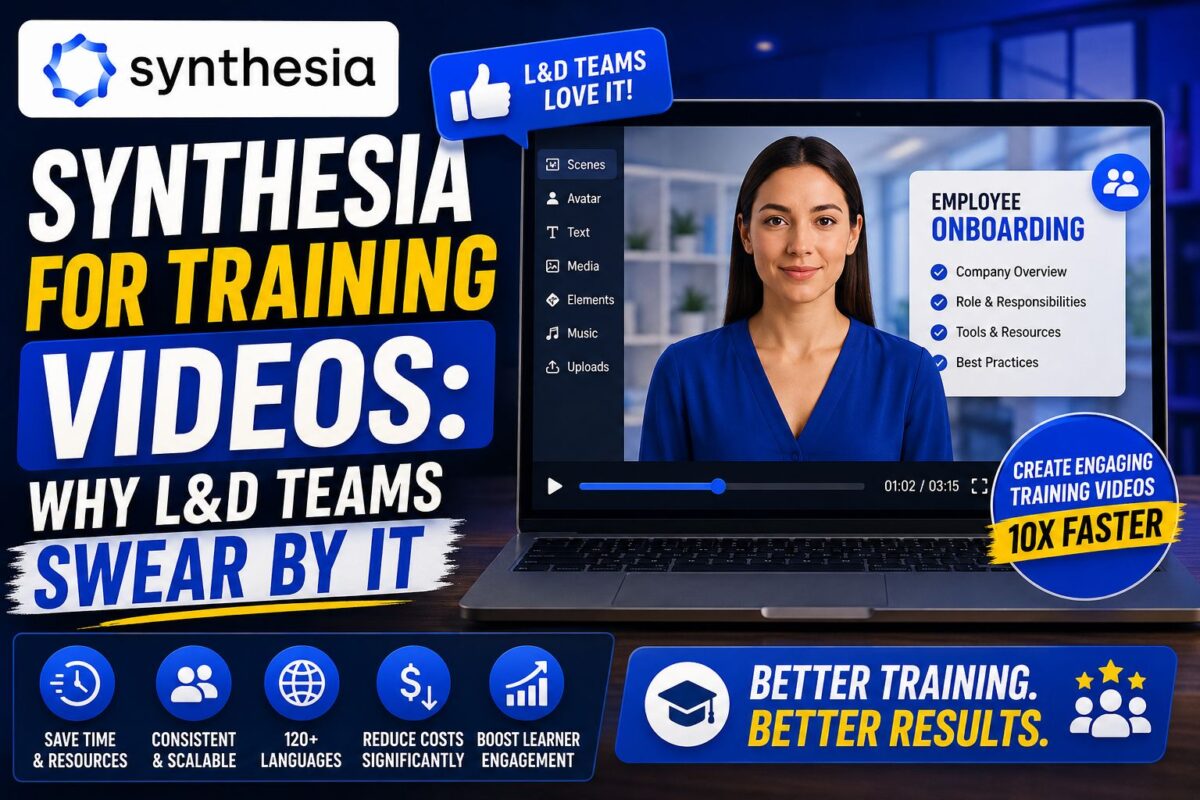
Synthesia for training videos isn't just the platform's best use case — it's the use case the entire product was built around, and the one where the ROI math stops being marketing and starts being arithmetic.
Every complaint that dogs Synthesia elsewhere — avatars that read as slightly synthetic, limited emotional range, structured templates — becomes irrelevant or even advantageous in a training context. Compliance modules don't need charisma. Onboarding videos don't need to go viral. They need to be accurate, consistent, multilingual, and cheap to update — which is a near-perfect description of what this platform produces.
Here's why L&D teams standardize on it, the real economics, and the workflow patterns that separate teams getting 10x value from teams burning credits. (Platform fundamentals, pricing, and honest limitations are all in my complete Synthesia review.)
Pilot Your First Compliance Module Free — No Card, No Sales CallKey Takeaways
- Training is where Synthesia's weaknesses don't matter: information delivery beats emotional connection, and corporate viewers accept professional AI presenters without engagement penalties.
- The killer feature is update-by-editing: when a policy changes, you edit the script and regenerate — no reshoots, no scheduling, no studio. Users report up to 90% production time reduction.
- Multilingual rollout is the multiplier: one training module localizes into 160+ languages, with reported localization savings up to 80%.
- Interactive features (quizzes, branching, clickable CTAs) turn passive videos into measurable learning — though SCORM export for LMS delivery requires an Enterprise plan.
Why Training Is Synthesia's Perfect Fit
The mismatch that sinks AI avatars elsewhere is an audience expectation problem: YouTube viewers expect a person, marketing audiences expect authenticity, and avatars deliver neither. Training audiences expect information from their employer — a context where a polished, consistent presenter is exactly right.
The evidence lines up with the logic. In corporate training contexts, reviewers consistently report that avatar quality “clears the bar easily” and most viewers won't flag the AI unless looking for it. One healthcare training producer described the platform as “a godsend” for content requiring frequent policy updates — the economics of re-hiring presenters for every revision simply don't exist with an avatar.
Contrast that with the platform's performance in personality-driven contexts — the engagement drops and audience pushback I documented in my analysis of Synthesia for YouTube content — and the pattern is clear: the same avatar that costs you 40% engagement on a vlog costs you nothing in a compliance module.
The Update-by-Editing Workflow: The Real ROI
Traditional training video has a dirty secret: production cost isn't the killer, maintenance is. A policy changes, a UI updates, a regulation shifts — and your professionally filmed module is obsolete. Reshooting means re-booking talent, studio time, and editing, so most organizations simply let training rot.
Synthesia's answer is structural: the video is the script. Edit the changed paragraph, hit regenerate, and the module is current — including every embedded copy, since embedded videos update automatically when the source changes. Corporate users report up to 90% reduction in production time versus traditional filming, and a typical 2–5 minute module takes 15–30 minutes to build.
That maintenance advantage compounds across a library. Fifty training modules with quarterly updates is a full-time production burden on film; on Synthesia it's an afternoon.
Build One Real Training Module Free — 10 Minutes/Month, No CardMultilingual Training: The Multiplier
For global organizations, localization is where the business case writes itself. One module, generated in 160+ languages with matched lip-sync — same visuals, same structure, per-language editable scripts. Reported localization cost reductions run up to 80% versus traditional re-recording with native presenters.
The compliance angle matters as much as the cost: consistent training content across regions, with controlled per-language scripts, is an auditor-friendly property that ad-hoc regional productions never achieve. The full pipeline — AI dubbing with voice preservation, lip-sync credit math, and what's Enterprise-gated — is covered in my guide to multilingual video translation.
Interactive Training: Beyond the Talking Head
Passive video is weak training, and Synthesia's interactive layer (Creator tier and up) addresses it directly:
- In-video quizzes with viewer scoring — knowledge checks with measurable results
- Branching scenarios — “what would you do?” paths for ethics, safety, and customer-handling training
- Clickable CTAs and hotspots — route learners to policies, forms, or next modules
- Screen recordings with avatar narration — the built-in recorder makes software training modules genuinely fast to produce
One structural gap to plan around: SCORM export — the packaging most LMS platforms require for completion tracking — is Enterprise-only. Smaller teams work around it with shared links and embedded videos, but if LMS-tracked compliance completion is a hard requirement, that's either an Enterprise conversation or a reason to evaluate the training-specialist competitor I compared in Synthesia vs Colossyan, where SCORM ships at self-serve pricing.
Best Practices from High-Performing L&D Teams
Chunk ruthlessly. Detailed training runs 5–7 minutes maximum per module; completion rates fall off a cliff beyond that. A 30-minute topic is six modules, not one video.
Template once, produce forever. Build a branded module template — intro pattern, layout system, outro — and every subsequent module inherits consistency for free. This is where the platform's rigidity becomes an asset.
Instructional design still comes first. The most-repeated warning from experienced users: AI accelerates production, it doesn't fix bad pedagogy. A weak slide deck converted to an avatar presenter is still weak training. Design the learning, then produce it.
Consider a custom avatar for cultural weight. Training delivered by a digital twin of your actual Head of Safety carries authority a stock avatar doesn't. Annual plans include Personal Avatar slots — the setup process and the $1,000 Studio option are covered in my custom avatar for training guide.
Measure with the interactive layer. Pre/post quiz deltas inside the videos give you learning-effectiveness data most training programs never collect.
Mind the credit meter. At 120 credits per finished minute with no rollover, preview before generating and batch your monthly production. Teams producing beyond ~30 minutes monthly should price Enterprise's unlimited minutes early.
Where Training Videos Are the Wrong Call
Honesty requires the boundary line. Skip Synthesia when the training content is:
- Emotionally heavy — harassment, grief, layoff-handling training where human gravity matters
- Physically demonstrative — hands-on skills that need real hands
- Persuasion-adjacent — culture and change-management content that's closer to internal marketing, where the authenticity problems from my marketing video use case analysis apply
For the informational core of a training library — policies, processes, software, onboarding, compliance — the fit is as good as AI video currently gets.
Start Your Training Library Free — Upgrade Only When the Pilot WorksFAQ: Synthesia for Training Videos
Is Synthesia good for corporate training videos?
It's the platform's strongest use case. The structured editor, update-by-script maintenance, multilingual generation, and interactive quizzes map directly onto L&D requirements, and avatar limitations that hurt in other contexts don't register with training audiences.
How long should a Synthesia training video be?
Marketing-style explainers: 45–90 seconds. Instructional content: 2–4 minutes. Detailed modules: 5–7 minutes maximum. Beyond that, split into a series — completion rates reward chunking.
Can Synthesia videos track completion in an LMS?
Only via SCORM export, which requires an Enterprise plan. Below that tier, teams use shareable links and embeds without formal completion tracking, or pair the videos with LMS-native quizzes.
How much time does Synthesia save on training production?
Corporate users report up to 90% production time reduction versus traditional filming — a 2–5 minute module takes 15–30 minutes to build, and updates take minutes rather than reshoot cycles.
The Bottom Line
Every tool has a context where its trade-offs disappear, and this is Synthesia's: audiences that want information, content that changes often, and organizations that need it in many languages at once. Design the learning properly, template your production, and budget the credit meter honestly — do that, and Synthesia for training videos delivers the rare AI-tool promise that actually survives the second year of use.
