
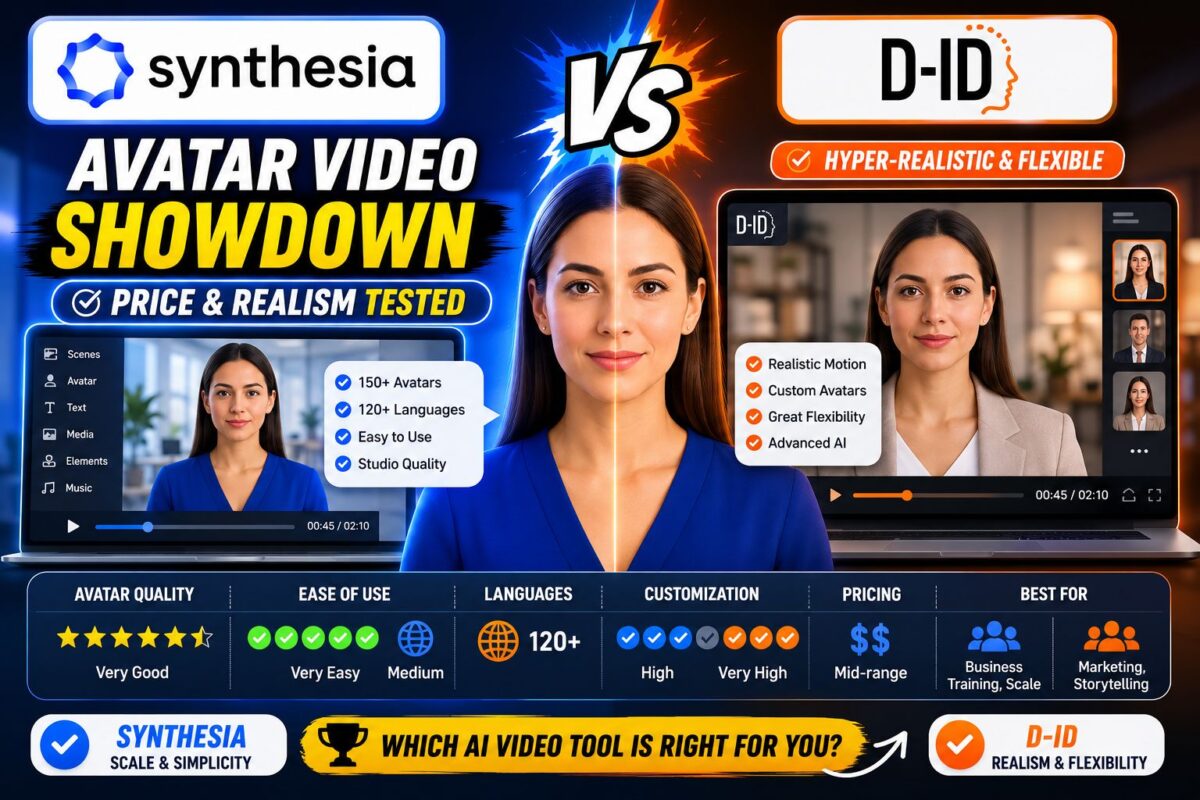
Synthesia vs D-ID looks like a David-and-Goliath matchup — the $2 billion category leader against a tool whose entry plan costs less than a sandwich — but it's really a comparison of two different product philosophies that happen to share a category.
The short version: Synthesia is a full video production studio built around lifelike avatars; D-ID is a photo-animation engine that makes any portrait talk, at a fraction of the cost. They overlap on “talking-head video from text,” and diverge on almost everything else. Pick by job, not by brand.
I've compared them on the dimensions that actually separate them: what each generates, output quality, pricing philosophy, and the specific workloads where the cheap tool genuinely beats the expensive one. (For the leader's complete standalone assessment, see my full Synthesia review.)
Try the Full-Studio Side Free Before Weighing the Price GapKey Takeaways
- D-ID starts at $5.90/month (Lite plan) versus Synthesia's $29/month — a dramatically lower per-minute cost, achieved by animating photos rather than rendering full studio avatars.
- Synthesia produces complete videos (scenes, templates, media, screen recording, 160+ languages); D-ID produces talking portraits you typically assemble elsewhere.
- Quality gap is real: Synthesia's avatars are studio-grade presenters; D-ID's animated photos are visibly synthetic but charming for the right formats.
- D-ID wins for personalized outreach, prototyping, and novelty formats; Synthesia wins for anything an organization publishes with its name on it.
What Each Tool Actually Is
Synthesia is an end-to-end video platform: a scene-based editor, 240+ full-body-motion stock avatars, 60+ templates, screen recording, brand assets, interactive elements, and generation in 160+ languages. You build complete, publishable videos inside it.
D-ID pioneered a different trick: upload any portrait photo — yourself, an illustration, a historical figure — add a script or audio, and the photo speaks with animated facial movement. It's the technology behind countless “talking ancestor photo” apps, and it has grown API-first into personalized-video and conversational-agent territory.
The distinction drives everything downstream: Synthesia sells finished videos; D-ID sells animated faces that usually become an ingredient in something else.
Output Quality: Different Leagues, Different Games
Judged as presenters, it's not close. Synthesia's avatars are purpose-built digital humans — full upper-body motion, script-adaptive expression, accurate lip-sync — that pass comfortably in professional contexts. D-ID's animated photos are obviously synthetic: head and facial movement on a static frame, with the slightly uncanny quality inherent to making a still image speak.
But “worse quality” misreads what D-ID is for. A talking photo isn't pretending to be a filmed presenter — it's a format of its own, and in personalized sales outreach (“your prospect's LinkedIn photo territory” aside — use your own face), quick internal explainers, and novelty content, the format's honesty about being synthetic can actually disarm viewers in a way near-real avatars don't.
The practical line: if the video represents your organization publicly, Synthesia's polish is worth its price. If the video is a one-to-one message, a prototype, or an experiment, D-ID's output is good enough and the economics are unbeatable.
See the Quality Gap Yourself — Synthesia's Free Plan Renders in MinutesPricing: The $23/Month Philosophy Gap
This is D-ID's headline argument, and it's legitimate:
| Synthesia | D-ID | |
|---|---|---|
| Entry paid plan | $29/mo ($18 annual) | $5.90/mo (Lite) |
| What it meters | Video minutes (120 credits/min) | Credits per generation |
| Effective cost | ~$2.90 per finished minute | Dramatically lower per minute |
| Free tier | ~10 watermarked min/month | Trial credits |
For short-form, high-frequency output — 20-second personalized clips, daily micro-updates — D-ID's cost per video can run an order of magnitude below Synthesia's. The full breakdown of the leader's meter, overages, and per-seat economics is in my Synthesia pricing guide; against D-ID's Lite plan, none of that math flatters the incumbent.
What the low price doesn't buy: the production environment. No comparable template system, scene editor, screen recording, or 160-language translation pipeline. Teams routinely pair D-ID output with a separate editor — at which point the total workflow cost narrows the gap considerably.
Where Each Tool Wins
Choose Synthesia if:
- You're producing training, onboarding, or corporate communication — complete videos, professionally packaged
- Multilingual delivery matters — the translation pipeline has no equivalent on D-ID
- The content is public-facing or brand-carrying, where visible synthetic-ness costs credibility
- You want one tool for the whole pipeline: script → scenes → interactive elements → publish
Choose D-ID if:
- You're sending personalized one-to-one videos at volume — sales outreach, customer milestones — where per-unit cost decides feasibility
- You're a developer embedding talking-avatar features via API into your own product
- You're prototyping avatar concepts before committing to premium tooling
- Budget is the binding constraint and the format's charm fits your use
The hybrid pattern worth knowing: several teams prototype scripts and formats on D-ID's cheap credits, then produce the validated winners on Synthesia. At $5.90/month, D-ID is nearly free R&D for your Synthesia spend.
The Broader Field
This matchup covers the price axis of the market, but not the realism axis — that battle is Synthesia vs HeyGen, where the challenger's Avatar IV genuinely passes as human. And for training teams specifically, the Colossyan matchup is the more relevant head-to-head. If you're mapping the whole landscape before deciding, my roundup of the top Synthesia alternatives ranks nine contenders by use case, D-ID included.
Run the Same Script on Synthesia Free — Then Judge the Price GapFAQ: Synthesia vs D-ID
Is D-ID cheaper than Synthesia?
Substantially — D-ID's Lite plan starts at $5.90/month versus Synthesia's $29/month, and its per-video cost for short clips is dramatically lower. The trade is production capability: D-ID animates faces, while Synthesia builds complete videos.
Are D-ID avatars as good as Synthesia's?
No — Synthesia renders full studio-grade digital presenters, while D-ID animates still photos with visible synthetic movement. For public, brand-carrying content the gap matters; for personalized outreach and prototyping it often doesn't.
Can D-ID replace Synthesia for training videos?
Rarely. Training programs need the scene editor, templates, screen recording, quizzes, and multilingual pipeline that constitute Synthesia's actual product. D-ID supplies a talking face, not a training production system.
Which has the better API?
Both offer capable APIs, but they serve different builders: D-ID's is the natural pick for embedding low-cost talking avatars in consumer apps; Synthesia's targets template-driven business video automation at higher per-minute cost.
The Bottom Line
This comparison has an unusually clean resolution: the tools barely compete. D-ID owns the bottom of the market — cheap, charming, API-friendly talking photos for personalization and play — while Synthesia owns organizational video production, where polish, languages, and workflow justify the 5x price. Decide what the video is for, and the Synthesia vs D-ID question answers itself before the free trials do.
