
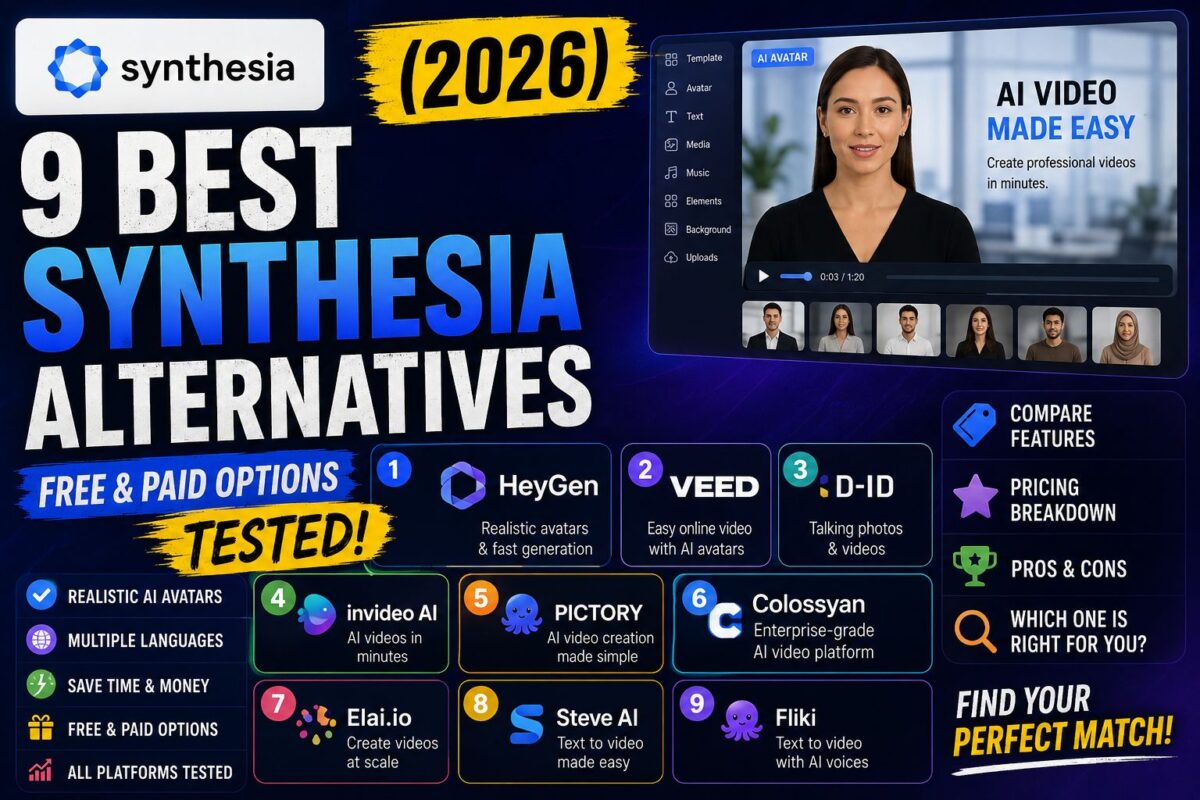
The best Synthesia alternatives in 2026 aren't just cheaper clones — several beat the category leader outright on avatar realism, output volume, or price, depending on what you're producing.
Quick note before we start: this guide covers alternatives to Synthesia.io, the AI video generator — not the piano-learning app that shares the name. If you're here for avatars, not arpeggios, you're in the right place.
Synthesia is excellent at what it does (my full Synthesia review explains where it earns its 4.7/5), but three complaints push people to shop around: metered minutes at ~$2.90/minute, avatars that still read as AI in emotional content, and essentials like SCORM locked behind Enterprise pricing. Every pick below solves at least one of those problems.
Key Takeaways
- HeyGen is the best overall alternative — Avatar IV realism plus unlimited standard videos.
- Colossyan is the training/e-learning specialist; D-ID is the budget photo-animation play from $5.90/month.
- Vidnoz offers the most generous free tier in the category; Veed and Descript win if you need real editing power, not just avatars.
- Match the tool to the job: no single platform wins every use case.
What to Look For in a Synthesia Alternative
Four factors separate the contenders: avatar realism (does the presenter pass as human?), output economics (per-minute metering vs unlimited/per-user pricing), language and translation depth, and feature accessibility (what's included vs enterprise-gated). Weigh them against your actual content mix — a compliance-training team and a TikTok marketer should pick completely different tools.
How I Evaluated These Tools
Each platform on this list was assessed against the same checklist: entry pricing verified against current 2026 plan pages, avatar output quality cross-referenced with verified G2 and Trustpilot review patterns (not vendor demos), free-tier generosity tested for real usability rather than marketing claims, and feature gating mapped tier by tier. Where hands-on testers published head-to-head results — like the creator who produced identical video sets on competing platforms and tracked actual spend — I've weighted that real-world data over spec sheets. Rankings reflect fit-for-purpose, not a single quality score, because the honest finding is that this market has no universal winner.
Benchmark the Original — Synthesia's Free Plan Takes 2 Minutes to Start1. HeyGen — Best Overall Synthesia Alternative
Best for: marketers, creators, and sales teams who need avatars that genuinely pass as human.
HeyGen is the obvious first stop, and for many people the last. Its Avatar IV technology renders micro-expressions, gestures, and head movement realistic enough that viewers routinely can't tell it's AI — the single biggest gap between it and Synthesia. Add talking photos, face swap, voice cloning, 175+ languages, and unlimited standard-avatar videos on paid plans, and it's the more creatively flexible platform across the board.
The trade-offs: premium Avatar IV footage is credit-metered (roughly 10 minutes/month on Creator), and the enterprise governance layer is thinner than Synthesia's. Pricing starts at $29/month ($24 annual).
I've run the full head-to-head in my Synthesia vs HeyGen comparison — the verdict splits cleanly by use case.
2. Colossyan — Best for Training and E-Learning
Best for: L&D teams that want Synthesia's core job at a lower entry price.
Colossyan attacks Synthesia's home turf directly: workplace training. It offers avatar emotions, multi-avatar conversation scenes (up to four in one take), built-in quizzes, and PowerPoint/PDF-to-video conversion — with SCORM support accessible below enterprise tiers. Avatar quality is widely considered the closest to Synthesia's in the category.
Pricing starts around $27–28/month, and the interactive learning features are arguably ahead of Synthesia's own. Full breakdown in my Synthesia vs Colossyan comparison.
3. D-ID — Best Budget Alternative
Best for: solo creators and experimenters who need talking-head video at the lowest possible cost.
D-ID takes a fundamentally different approach: instead of full studio avatars, it animates photos — upload a portrait, add a script, get a talking video. The Lite plan starts at just $5.90/month, a dramatically lower per-minute cost than anything else on this list.
The output is simpler and more obviously synthetic than Synthesia or HeyGen, but for personalized outreach, quick explainers, and prototyping, the economics are unbeatable. See where cheap-and-simple beats full-studio in my Synthesia vs D-ID breakdown.
Not Ready to Switch? Grab Synthesia's Free Plan and Benchmark It First4. Elai.io — Best Price-to-Feature Ratio
Best for: teams that need API automation and translations on a budget.
Elai flies under the radar but delivers 80+ avatars, automatic translations into 65+ languages, an actively developed API, and useful LMS integrations from around $23/month. It's the pragmatic pick when you want most of Synthesia's workflow at two-thirds the price and don't need the premium avatar polish.
5. Vidnoz — Best Free Synthesia Alternative
Best for: creators on a zero budget.
Vidnoz's free tier is the most generous in the category — up to 30 free minutes per month, no credit card required — compared to Synthesia's ~10 watermarked minutes. Avatar quality sits a tier below the leaders, but for freelancers, social managers, and anyone validating whether AI video even fits their workflow, it's the lowest-risk starting point. (Synthesia's own no-cost option is covered in my Synthesia free plan guide if you want to compare limits.)
6. DeepBrain AI (AI Studios) — Best for Broadcast-Style Avatars
Best for: news-style, presenter-led content.
DeepBrain's avatars are built from real footage of actual presenters, giving output a broadcast-anchor quality that suits news updates, corporate announcements, and formal explainers. Plans start around $24/month with ChatGPT-integrated script generation. Avatar variety (100+) trails the leaders, but realism in the newsreader format is excellent.
7. Veed — Best If You Need a Real Video Editor Too
Best for: teams whose videos need editing, not just generating.
Veed is a full browser-based video editor — subtitles, screen recording, trimming, branding — that added AI avatars, rather than an avatar tool with a thin editor bolted on. If your workflow mixes real footage with AI segments, Veed's 4.6/5 G2 rating across 2,100+ reviews reflects genuinely strong editing fundamentals that Synthesia deliberately doesn't attempt.
8. Descript — Best for Podcast and Screen-Based Content
Best for: creators editing talking content by editing text.
Descript's transcript-based editing (delete a word, delete it from the video), AI voice cloning, filler-word removal, and screen recording make it the strongest tool for podcasts, tutorials, and course content built from real recordings. It's less an avatar generator than a different philosophy of video production — and for many “faceless” workflows, the better one.
9. InVideo — Best for Faceless YouTube Channels
Best for: YouTube automation and long-form content from prompts.
InVideo generates full 10-minute YouTube videos from a single prompt, with 5,000+ templates and an “AI Twins” custom avatar feature included in the platform rather than sold as a four-figure add-on. If your goal is channel volume rather than corporate training, it's purpose-built for the job — I explain why avatar-first tools struggle on YouTube in my honest take on Synthesia for YouTube.
Which Synthesia Alternative Should You Pick?
| Your situation | Pick |
|---|---|
| Need avatars that pass as human | HeyGen |
| Corporate training on a budget | Colossyan |
| Cheapest possible talking-head video | D-ID |
| API automation + translations, low cost | Elai.io |
| Zero budget, testing the waters | Vidnoz |
| Broadcast/news presenter style | DeepBrain AI |
| Need real editing capabilities | Veed or Descript |
| Faceless YouTube at volume | InVideo |
| Enterprise L&D, multilingual, compliance | Stay with Synthesia |
That last row matters. If your use case is structured, multilingual business training at scale, none of these alternatives actually beats the incumbent — Synthesia's translation pipeline, consent framework, and enterprise polish remain the category benchmark. The alternatives win at the edges Synthesia chose not to fight for.
Still the Best for Training? Test Synthesia Free Before You DecideFAQ: Synthesia Alternatives
What is the best free alternative to Synthesia?
Vidnoz offers the most generous free tier (up to 30 minutes/month), while HeyGen's free plan allows 3 short videos monthly with downloadable 720p output — something Synthesia's free tier restricts.
Is HeyGen better than Synthesia?
For avatar realism and creative features, yes. For enterprise training, localization workflow, and governance, Synthesia still leads. Most teams should decide based on whether videos need to persuade (HeyGen) or inform at scale (Synthesia).
What's the cheapest Synthesia alternative?
D-ID, with plans from $5.90/month using photo animation instead of full studio avatars. Elai.io (~$23/month) is the cheapest full-featured avatar platform.
Why do people switch away from Synthesia?
Three reasons dominate: per-minute costs that punish volume production, avatar expressiveness limits in emotional content, and essential features (SCORM, brand kits, 1-click translation) being gated to Enterprise contracts.
The Bottom Line
The AI video market matured enough that “which tool is best” is the wrong question — the right one is “best at what.” HeyGen owns realism, Colossyan owns affordable training, D-ID owns budget, and Synthesia still owns enterprise-scale multilingual production. Match the tool to your actual content mix and any of these Synthesia alternatives can outperform the default choice for your specific job.
