
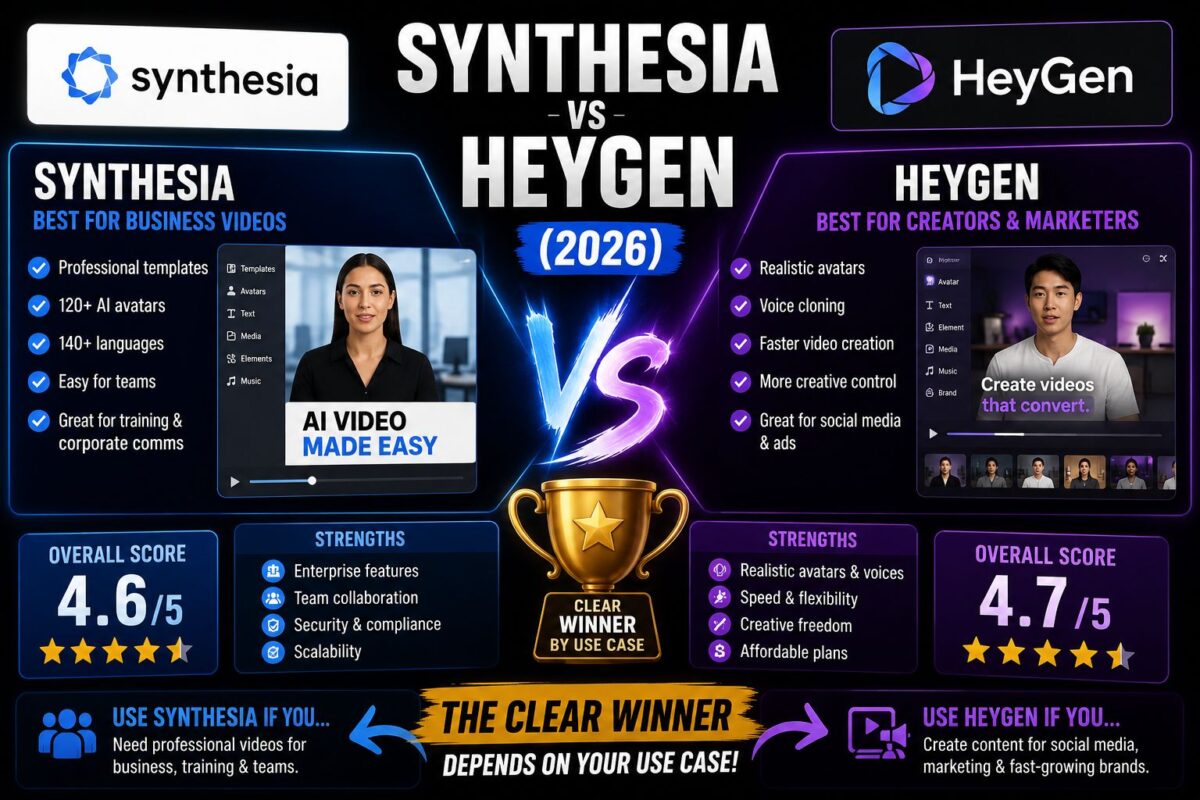
Synthesia vs HeyGen is the defining matchup in AI video right now — the enterprise incumbent against the fastest-growing challenger — and the honest answer is that neither “wins” outright.
Here's the verdict up front: HeyGen wins on avatar realism and creative flexibility; Synthesia wins on enterprise structure, multilingual training workflows, and predictable billing. Pick based on whether your videos need to connect or need to scale.
I compared both platforms on the five factors that actually change outcomes: avatar quality, pricing models, language support, feature gating, and team economics. (My full standalone evaluation lives in this in-depth Synthesia review if you want the complete picture on one side first.)
Key Takeaways
- HeyGen's Avatar IV renders presenters that genuinely pass as human — viewers regularly can't tell. Synthesia's avatars are polished but detectable in emotional or close-up content.
- Pricing: both start at $29/month monthly, but annual billing favors Synthesia ($18/mo vs HeyGen's $24/mo). HeyGen offers “unlimited” standard videos; Synthesia caps everything at metered minutes.
- Synthesia leads for L&D and enterprise: stronger structured editor, 240+ avatars, 160+ languages, and the deepest compliance posture (SOC 2, GDPR, ISO 42001).
- Team math differs sharply: HeyGen Business is $149/mo + $20 per extra seat; Synthesia teams of 3+ editors get pushed toward custom Enterprise contracts.
Synthesia vs HeyGen: Quick Comparison Table
| Factor | Synthesia | HeyGen |
|---|---|---|
| Avatar realism | Polished, professional, slightly “AI” | Avatar IV: near-human, micro-expressions |
| Stock avatars | 240+ | 100+ (plus talking photos, face swap) |
| Languages | 160+ | 175+ |
| Entry price | $29/mo ($18 annual) | $29/mo ($24 annual) |
| Output model | Metered minutes (120–360/yr) | “Unlimited” standard videos; Avatar IV metered by credits |
| Team pricing | Per-seat plans → custom Enterprise | Business $149/mo + $20/seat |
| SCORM / LMS | Enterprise tier only | Included from lower tiers |
| Best for | L&D, compliance, multilingual training | Marketing, creators, sales outreach |
| G2 rating | 4.7/5 (~2,400 reviews) | 4.8/5 (~1,200 reviews) |
Avatar Quality: HeyGen Wins on Realism
This is the category with the clearest gap. HeyGen's Avatar IV technology produces avatars with natural micro-expressions, head tilts, and gestures that regularly fool viewers — one tester reported colleagues asking when he “filmed” an AI-generated demo. If your content depends on the presenter feeling human, HeyGen is ahead.
Synthesia's avatars are the more consistent professional product: excellent lip-sync, expressive avatars that adapt tone to the script, and a larger library (240+) with strong diversity for corporate representation. But reviewers consistently describe a slight uncanny valley effect in close-ups and emotionally loaded scripts.
There's a catch in HeyGen's realism, though: Avatar IV burns premium credits fast — roughly 200 credits buys about 10 minutes of Avatar IV footage per month on the Creator plan. The “unlimited videos” headline applies to standard avatars, not the flagship ones you actually want.
Winner: HeyGen — with an asterisk on credit burn.
Pricing: Different Models, Different Traps
At the entry level the platforms look identical ($29/month), but the models diverge fast.
Synthesia meters everything. You get ~10 minutes/month on Starter, ~30 on Creator, at an effective $2.90/minute with no rollover. The upside is predictability — no credit categories to decode. The full fee structure (overages, seat costs, the $1,000 avatar add-on) is in my Synthesia pricing breakdown.
HeyGen splits standard from premium. Standard avatar videos are unlimited on paid plans — genuinely great value for volume — while Avatar IV and advanced features consume a monthly credit allowance. One hands-on tester producing 25 identical videos on each platform reported spending $384 on HeyGen's “unlimited” plan versus $95 on Synthesia's “limited” one, entirely because of premium credit burn.
The lesson: map your actual content mix before trusting either headline. Volume producers using standard avatars → HeyGen. Predictable short-form business content → Synthesia.
Winner: tie — it depends entirely on what you produce.
Compare for Yourself — Start with Synthesia's Free PlanLanguages and Translation: Closer Than You'd Think
HeyGen advertises 175+ languages to Synthesia's 160+, but raw counts miss the workflow difference. Synthesia's translation pipeline — one-click full-video translation, AI dubbing that preserves the speaker's voice, and lip-sync matching — is the more mature localization system, and G2 reviewers repeatedly call multilingual translation Synthesia's clearest competitive advantage. The catch: 1-click translation is gated to Enterprise. My Synthesia video translation guide covers the full capability.
HeyGen counters with strong video translation of existing footage (upload a real video, get it dubbed with lip-sync) — arguably the better tool if you're localizing human-recorded content rather than avatar videos.
Winner: Synthesia for avatar-video localization at scale; HeyGen for translating real footage.
Enterprise and Team Features: Synthesia's Home Turf
Both platforms are SOC 2 Type II certified with GDPR compliance, SAML SSO, and role-based access. The differences show up in packaging:
- HeyGen includes SCORM export, branching, and quizzes from lower tiers. Synthesia locks SCORM and brand kits behind Enterprise — a real cost for mid-sized L&D teams.
- Synthesia's collaboration layer is deeper: workspaces, review flows, commenting, and the strongest content-moderation and consent framework in the category (ISO 42001 certified).
- Team economics: HeyGen's self-serve Business plan ($149/mo + $20/seat) scales transparently. Synthesia teams beyond a couple of editors enter custom-quote territory — median ~$30K/year per Vendr data, detailed in my Synthesia Enterprise pricing guide.
Winner: Synthesia for governance and Fortune-500 procurement; HeyGen for mid-market transparency.
Switching Between Them: What to Know
Already on one platform and eyeing the other? A few practical realities before you migrate.
Projects don't transfer. Neither platform imports the other's project files — you're rebuilding scenes, not converting them. Scripts copy over trivially, but layouts, brand assets, and avatar selections start from zero. Budget rebuild time proportional to your template library, not your video count.
Custom avatars are the real switching cost. A personal avatar trained on one platform stays there. If you've invested in Synthesia's $1,000/year Studio avatar or built your presence around a HeyGen digital twin, that asset anchors you more than any contract does.
Watch the annual-billing trap. Both platforms discount annual prepayment heavily (Synthesia by 28–38%). If you're genuinely unsure, run both on monthly billing for one production cycle before committing a year to either — the $11–25/month premium is cheap insurance against locking into the wrong model.
Teams should pilot with one real project. The platforms feel similar in demos and different in production: credit burn, render queues, review workflows, and moderation policies only reveal themselves under actual deadlines.
Which Should You Choose?
Choose Synthesia if:
- You're an L&D, HR, or compliance team producing structured training at scale
- Multilingual avatar-video localization is core to the job
- Your organization needs enterprise security, consent guarantees, and predictable metered billing
- Your videos inform rather than persuade
Choose HeyGen if:
- Avatar realism is the deciding factor — marketing, sales outreach, social content
- You produce high volumes of standard-avatar video and want unlimited output
- You need talking photos, face swap, or personalized one-to-one sales videos
- You want SCORM and interactivity without an Enterprise contract
Still torn? Both platforms offer free tiers, and the honest move is generating the same 60-second script on each — the difference in feel is obvious within minutes. And if neither fits, my roundup of the best Synthesia alternatives covers seven more options, including the training-specialist Colossyan at a lower price point.
Test Synthesia Free — 10 Minutes/Month to Run Your Own ComparisonFAQ: Synthesia vs HeyGen
Is HeyGen better than Synthesia?
For avatar realism and creative flexibility, yes — Avatar IV is currently the most lifelike presenter technology available. For enterprise training, multilingual localization, and governance, Synthesia remains the stronger platform.
Which is cheaper, Synthesia or HeyGen?
On annual billing, Synthesia starts lower ($18/mo vs $24/mo). But total cost depends on usage: HeyGen's unlimited standard videos favor volume producers, while premium Avatar IV credits can quietly multiply spend.
Do both platforms have free plans?
Yes. Synthesia's free tier includes ~10 watermarked minutes per month; HeyGen's free plan allows up to 3 short videos per month with 720p downloads.
Which is better for corporate training?
Synthesia — the structured editor, translation pipeline, and compliance posture are built for L&D. HeyGen's cheaper SCORM access makes it worth a look for smaller training teams, though.
The Bottom Line
The Synthesia vs HeyGen decision reduces to one question: does your video need to feel human, or does it need to scale across an organization? HeyGen has the realism crown; Synthesia has the enterprise machine. Answer that question honestly, run one identical test video on each free plan, and the Synthesia vs HeyGen debate settles itself in an afternoon.
