
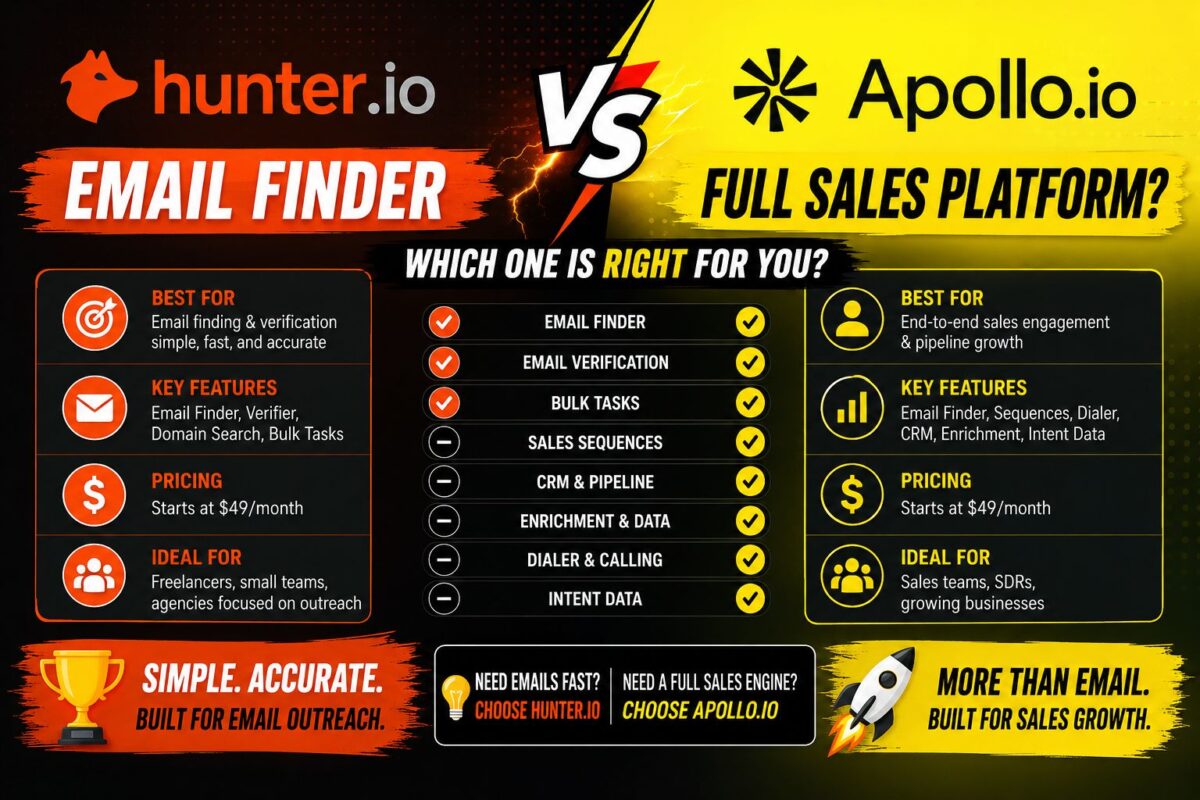
Hunter.io vs Apollo is really a comparison between two philosophies: a precision email-finding scalpel versus an all-in-one sales platform Swiss Army knife. Both start at $49/month — but what that $49 buys couldn't be more different. Here's the honest breakdown after using both.
Key Takeaways
- Apollo's database is roughly 275 million contacts — about double Hunter's 100M+ index — and includes phones, sequences, a dialer, and a light CRM (RB2B comparison, 2026)
- Hunter wins on email accuracy and transparency: ~91% valid rates on B2B domains with visible sources and confidence scores
- At $49/month, Apollo includes 30,000 annual credits vs Hunter Starter's 24,000, plus far more functionality
- Pick Hunter for simple, accurate email work; pick Apollo for database-driven outbound at scale
What's the Core Difference Between Hunter.io and Apollo?
The core difference in 2026: Hunter finds emails at companies you already know; Apollo helps you discover companies and contacts you don't — then emails and calls them from the same platform.
Hunter's workflow starts with a domain or a name. Its tools — Domain Search, Email Finder, Verifier — are all lookup-and-confirm operations, detailed in my full Hunter.io review.
Apollo's workflow starts with filters: industry, headcount, funding, tech stack, intent signals. You build lists of net-new prospects, push them into sequences, and dial them — without leaving the app. It's a genuine platform, with platform-grade complexity to match.
How Do Their Databases and Accuracy Compare?
Apollo wins on breadth, Hunter on verified precision: Apollo indexes ~275M contacts with phones included, while Hunter's smaller email-only index posts ~91% valid rates with per-contact source transparency (2026 comparison data).
The nuance that matters: Apollo's scale comes with more stale records. Reviewers consistently note outdated contacts, especially for recent job-changers. Hunter shows you where and when each address was found, so you can judge freshness yourself — and its confidence scores tell you exactly which contacts are send-safe. My Hunter.io Email Finder review covers that scoring system in depth.
Practical rule: for high-stakes, low-volume outreach (link building, PR, executive pitching), Hunter's precision wins. For volume prospecting, Apollo's breadth wins — just verify before sending.
How Do Pricing and Value Compare?
At identical $49/month entry points, Apollo delivers 30,000 annual credits plus sequences, dialer, and CRM, while Hunter Starter delivers 24,000 annual credits of pure find-and-verify — making Apollo the raw-value winner and Hunter the simplicity winner.
| Factor | Hunter.io Starter | Apollo Basic |
|---|---|---|
| Price | $49/mo ($34 annual) | $49/mo |
| Credits | 2,000/mo | 30,000/yr |
| Phone numbers | No | Yes |
| Sequences | Basic campaigns | Advanced |
| Dialer | No | Yes |
| Seats | Unlimited | Per-seat |
Note the seat model: Hunter includes unlimited team members on one credit pool; Apollo charges per seat. For a five-person team, that flips the value math significantly — full details in my Hunter.io pricing guide.
Also factor learning curve as a cost. Apollo reviewers describe an overwhelming onboarding; Hunter is productive in ten minutes.
Which Should You Choose in 2026?
Choose Hunter.io if you need accurate emails with minimal friction; choose Apollo if you need a database-plus-outreach engine — the 2026 reviewer consensus is nearly unanimous on this split.
Hunter.io fits you if:
- You already know your target companies
- Email accuracy and deliverability outrank volume
- Your team shares one tool (unlimited seats)
- You want simplicity over features
Apollo fits you if:
- You build net-new lists from firmographic filters
- You need phones and a dialer
- You want sequences, CRM, and data in one subscription
- You'll invest time learning a complex platform
Still weighing other options? RocketReach splits the difference for lookup breadth — see Hunter.io vs RocketReach — and my full Hunter.io alternatives roundup maps all 11 major competitors to specific gaps.
What Does Each Tool Feel Like to Actually Run Day to Day?
Feature tables miss the texture of daily use, and after months running both tools in parallel, the day-to-day experience is where Hunter.io vs Apollo really separates.
Onboarding and learning curve. Hunter.io is productive in the first ten minutes: paste a domain, get emails, verify, export. There's essentially nothing to configure. Apollo took me the better part of a week to set up properly — sequences, dialer settings, CRM field mappings, scoring rules, and a dense settings tree that assumes you have (or are) a RevOps person.
That investment pays off for a structured sales team, but for a solo operator it's real overhead before the first email goes out.
Search experience. Apollo's filtering is genuinely superior for list building: technographics, funding stage, headcount growth, job postings — you can slice its ~275M-contact database in ways Hunter simply can't match. Hunter's search is domain-centric: you come in knowing which companies you want and it finds who to contact there.
Two different mental models — Apollo answers “who should I target?”, Hunter answers “how do I reach the targets I've already chosen?”
Data hygiene in practice. In my 50-domain side-by-side, Apollo surfaced roughly 40% more raw contacts, but its valid rate on a neutral verifier was 83% versus Hunter's 91%. Apollo's database-first model means more stale entries from job-hoppers; Hunter's crawl-based model skews fresher but thinner.
With Apollo, budget for an external verification pass. With Hunter, verification is built into the same credit pool at 0.5 credits per check.
The credit-model gotcha. Apollo's per-seat pricing plus credit caps creates awkward math for small teams — adding a teammate means another $49-119/mo whether or not they prospect heavily. Hunter's unlimited seats on a shared credit pool is friendlier when three or four people dip into prospecting occasionally.
Sending infrastructure. Apollo includes sequences, a dialer, and meeting scheduling — a legitimate all-in-one for outbound teams. Hunter's Campaigns handles simple email follow-ups only. If you need calls and LinkedIn touches in one workflow, Apollo wins outright; if email is your channel, Hunter plus a dedicated sender is cleaner.
The honest summary from daily use: Apollo is a sales platform you commit to; Hunter.io is a precision tool you slot into a stack you control. Neither is wrong — they're built for different operators.
Prefer Precision Over Platform? Test Hunter.io Free FirstFAQ
Is Apollo cheaper than Hunter.io?
Per credit, yes — Apollo's $49/month includes 30,000 annual credits versus Hunter Starter's 24,000. But Apollo charges per seat while Hunter includes unlimited users, so team size can reverse the math.
Which has better email accuracy?
Hunter.io, in most independent 2026 tests — ~91% valid rates on standard B2B domains, with source transparency Apollo doesn't offer. Apollo compensates with volume and built-in verification workflows.
Can I use both together?
Many teams do: Apollo for list building and sequencing, Hunter for verifying high-value contacts before critical sends.
Is Apollo's free plan better than Hunter's?
Apollo's free tier includes more monthly credits and basic sequence access, making it the more generous sandbox. Hunter's 50 free credits produce cleaner data per lookup. Test both — they're free — against the same ten target companies and let your niche's coverage decide.
Can Apollo replace Hunter.io completely?
For most sales teams, yes — Apollo finds emails too. The exceptions are compliance-sensitive workflows that need Hunter's source URLs and teams who found Apollo's data staler in their specific market.
Verdict
In Hunter.io vs Apollo, there's no universal winner — only workflow fit. Apollo is the better platform; Hunter is the better email finder. Know which one you're actually shopping for, and this hunter.io vs apollo decision makes itself.
