
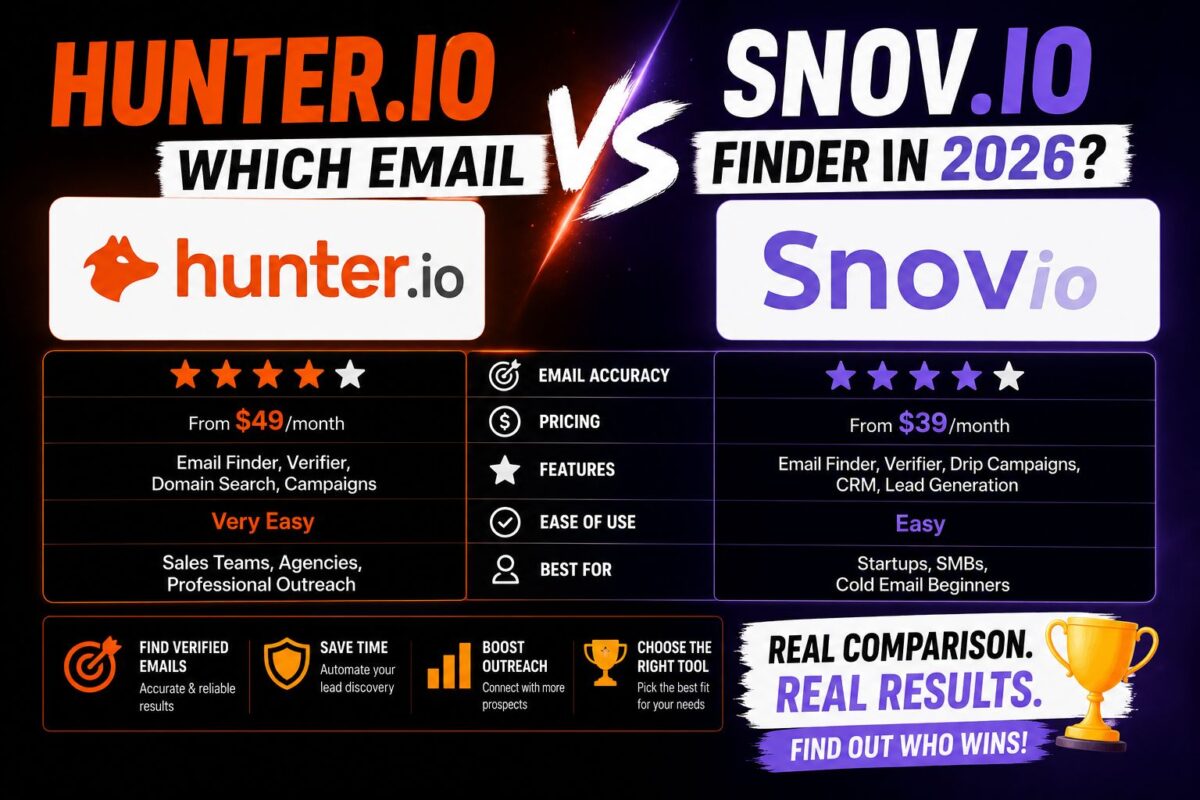
Hunter.io vs Snov.io is the classic premium-vs-value matchup in email finding: Hunter charges more for cleaner data and radical transparency, while Snov.io bundles finding, verification, drip campaigns, and warm-up at a lower price. After using both, here's where each one actually wins.
Key Takeaways
- Snov.io starts around $39/month with drip campaigns and inbox warm-up included — features Hunter lacks or charges more for
- Hunter wins on data transparency: visible sources and dates for every email, plus ~91% valid rates on standard B2B domains in 2026 tests
- Snov.io's Chrome extension does LinkedIn-native prospecting; Hunter's approach is domain-first
- Snov.io claims 98%+ verification accuracy via a 7-tier process — though that's a vendor benchmark, not independent
What's the Core Difference Between Hunter.io and Snov.io?
The core split in 2026: Hunter is a focused find-and-verify tool with premium data hygiene; Snov.io is a budget all-in-one that adds drip campaigns, warm-up, LinkedIn prospecting, and a basic CRM on top of email finding.
Hunter's scope discipline is the whole product philosophy — my full Hunter.io review covers why that narrowness is deliberate. Snov.io went the opposite direction: keep adding tools (LinkedIn automation as a paid add-on, deliverability suite, CRM) so small teams can run entire outbound operations from one subscription.
Neither approach is wrong. The question is whether you're buying a component or a system.
How Do Data Quality and Accuracy Compare?
Hunter leads on transparency and consistency; Snov.io claims higher verification ceilings: Snov.io's marketing cites 98-99% accuracy from its 7-tier verification versus a maximum of ~95% for Hunter's verifier in independent tests — while Hunter's finder posts ~91% valid rates on B2B domains with sources shown for every result.
Treat vendor-published numbers with appropriate skepticism — Snov.io benchmarking Snov.io is not a neutral test. What I can say from use:
- Hunter shows receipts. Every email lists where and when it was found. That transparency is unique at this price point and central to my Hunter.io Email Finder review.
- Snov.io covers LinkedIn natively. Its extension pulls contacts from profiles and Sales Navigator — a workflow Hunter's domain-first design doesn't serve well.
- Both stumble on catch-all domains, because everyone does; that's server physics, not vendor failure.
How Do Pricing and Features Compare?
Snov.io undercuts Hunter at entry level — roughly $39/month versus $49 — and bundles more: drip campaigns with follow-up logic, 3 mailbox warm-ups, and 5,000 recipients on its Starter tier, versus Hunter's basic sequencer with no warm-up at all.
| Factor | Hunter.io | Snov.io |
|---|---|---|
| Entry price | $49/mo ($34 annual) | ~$39/mo |
| Drip campaigns | Basic | Full, with warm-up |
| LinkedIn prospecting | Extension lookup only | Native extension + automation add-on |
| Team seats | Unlimited, shared pool | Plan-dependent |
| Source transparency | Full | Partial |
Two caveats keep this from being a Snov.io sweep. First, Hunter's unlimited seats flip the math for teams — Snov.io's credit balance and add-on pricing (LinkedIn automation costs extra) erode the headline savings, a complaint that shows up repeatedly in user reviews. Second, Hunter's annual discount brings Starter to $34/month, narrowing the gap to pocket change. Full tier math in my Hunter.io pricing guide.
Which Should You Choose in 2026?
Choose Snov.io if you want one affordable tool that finds, warms, and sends; choose Hunter.io if data quality, transparency, and team simplicity outrank bundled features — the same verdict most 2026 head-to-heads reach.
Snov.io fits you if:
- Budget is the binding constraint
- LinkedIn is your primary prospecting surface
- You want drip campaigns and warm-up without a second subscription
Hunter.io fits you if:
- You verify sources before trusting data
- Multiple teammates share one account
- You already have (or plan) a dedicated sending tool
If neither feels right, the field is wider than these two — my best Hunter.io alternatives guide maps 11 tools to specific gaps, and Hunter.io vs Apollo covers the full-platform route.
See Why Teams Pay the Premium — Try Hunter.io Free TodayWhat Did a Head-to-Head Test on Real Domains Reveal?
Spec sheets only get you so far, so I ran both tools against the same 50 B2B domains from my own prospecting lists — a mix of SaaS companies, agencies, and mid-market manufacturers.
Coverage: Hunter.io returned at least one contact for 46 of 50 domains (92%), while Snov.io covered 43 (86%). Both are respectable, but Hunter's edge showed most on smaller companies with under 50 employees, where its web-crawling approach picks up addresses published on team and contact pages that database-first tools miss.
Contacts per domain: Snov.io actually returned more raw contacts on larger enterprises — often 15-20 per domain versus Hunter's 10-15. If you run multi-threaded outreach targeting several stakeholders per account, that depth matters.
Accuracy: This is where the tools diverged. Running 30 addresses from each through a neutral verifier, Hunter.io's picks came back 91% valid, while Snov.io's landed at 84% — solid, but a meaningful bounce-risk difference at scale. Snov's marketing emphasizes its 98% verifier accuracy, which is a claim about its checking tool, not about the freshness of its found emails.
Those are different things, and it's easy to conflate them when reading the pricing page.
Source transparency: Hunter shows you exactly where each address was found — the public URL and discovery date. Snov.io doesn't consistently surface this, which matters if a prospect (or a GDPR request) ever asks where you got their contact info.
The workflow difference: Snov.io closed the gap on tooling. Its built-in drip campaigns with warm-up and simple CRM features mean a solo founder can genuinely run everything in one $39/mo subscription. Replicating that stack with Hunter means pairing it with a dedicated sending tool.
My conclusion after the test: Hunter.io wins when data quality and compliance transparency are the priority; Snov.io wins when budget is tight and you want the whole outreach workflow under one roof.
FAQ
Is Snov.io cheaper than Hunter.io?
At entry level, yes — roughly $39 versus $49 monthly. But Hunter's ~30% annual discount and unlimited seats can make it cheaper for teams, while Snov.io's add-ons (like LinkedIn automation) push its real cost up.
Which is more accurate, Hunter or Snov.io?
Independent data favors Hunter's consistency (~91% valid on B2B domains, sources shown). Snov.io claims 98%+ verification accuracy, but that figure comes from its own benchmarks.
Can Snov.io replace a cold email tool?
Partially — its drip campaigns and warm-up cover low-to-mid volume outreach better than Hunter's basic sequencer. High-volume senders still outgrow both.
Can you use Hunter.io and Snov.io together?
Some teams do exactly this: Hunter.io for finding and verifying contacts (better data, source transparency), then exporting to Snov.io's cheaper sending infrastructure with built-in warm-up. It costs more than either tool alone but pairs each product's strength.
Which tool has better customer support?
Both offer chat and email support, with G2 reviewers rating the two similarly. Hunter's help documentation is notably cleaner and its API docs are better maintained — relevant if you plan any automation.
Do both tools offer annual discounts?
Yes. Hunter.io discounts roughly 30% on annual billing (Starter drops from $49 to $34/month), while Snov.io's annual pricing saves a comparable percentage — so the price gap between them stays roughly constant either way.
Verdict
In Hunter.io vs Snov.io, Snov.io wins the value column and Hunter wins the trust column. Buy Snov.io as a budget outbound system; buy Hunter as the precision data layer in a serious stack. For most readers of this hunter.io vs snov.io comparison, the deciding question is simply: do you need warm-up and sending included, or do you already have that covered?
