
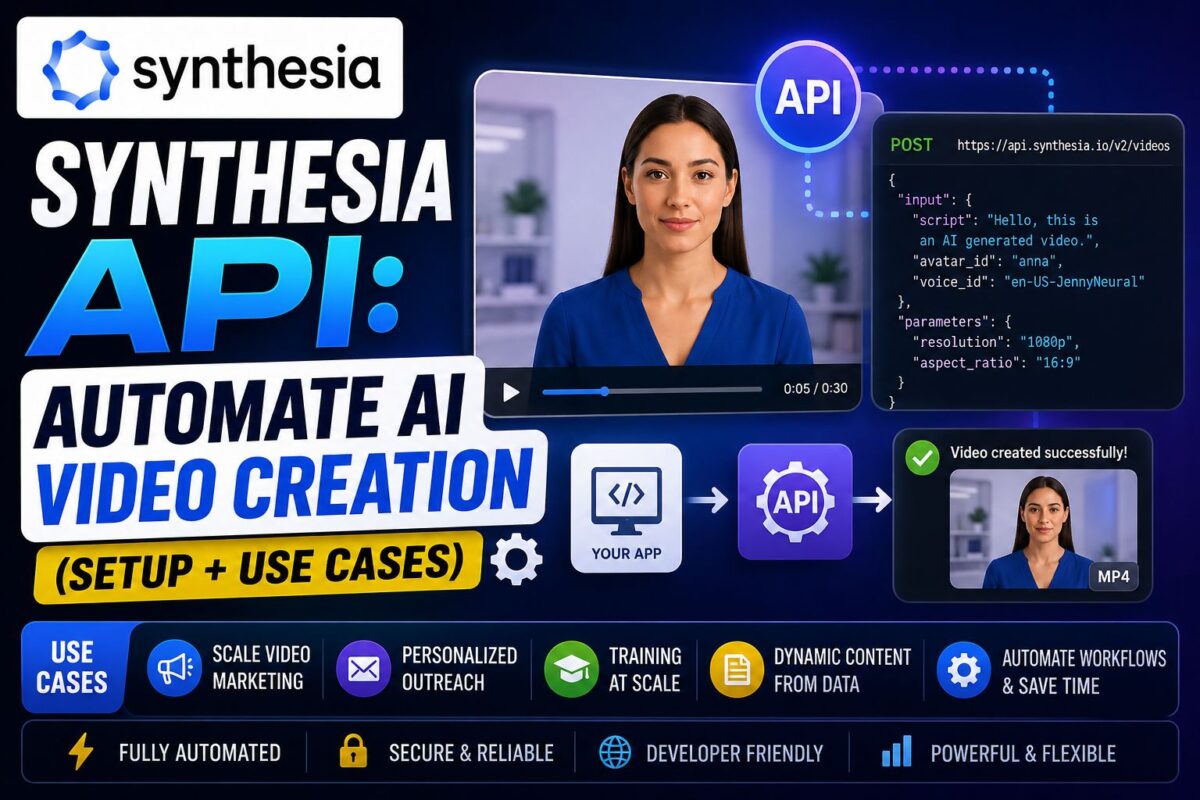
The Synthesia API turns the platform from a video editor into a video pipeline — scripts go in programmatically, finished avatar videos come out, and no human opens the editor in between.
That's the pitch, and for the right workloads it delivers: personalized sales videos generated from CRM rows, training modules that rebuild themselves when documentation changes, product videos spun up from catalog data. But the API inherits every constraint of the underlying platform — minute metering, plan gating, and moderation — and those constraints shape what's realistically buildable more than the endpoints do.
Here's what the API actually offers, what it requires, and where automation genuinely pays off. (For the platform fundamentals underneath all this, start with my full Synthesia review.)
Explore Synthesia Free First — API Ships with the Creator TierKey Takeaways
- API access starts on the Creator plan ($64–89/month) — it's not available on Free or Starter tiers.
- API-generated video deducts from your plan's normal allowance (up to 360 minutes/year on Creator), with additional usage available as a paid add-on.
- The killer feature is bulk personalization: pair a template with a CSV/XLSX upload and generate hundreds of individualized videos from one design.
- Best-fit workloads: personalization at scale, documentation-driven regeneration, and SaaS integrations — not high-volume general publishing, where minute costs dominate.
What Can the Synthesia API Do?
The API exposes the platform's core generation loop as endpoints: create a video from a script and template, check render status, retrieve the finished file, and manage assets. In practice, four capabilities matter:
Template-driven generation. You design a video template once in the editor — layouts, avatar, branding — and the API populates its variable fields (names, product details, data points) per request. This template-plus-variables model is the intended pattern; generating fully freeform videos from raw API calls works but wastes the design leverage.
Bulk personalization from spreadsheets. The headline workflow: pick a template, upload a CSV or XLSX, and generate hundreds of personalized videos in one operation — one row, one video. Sales outreach (“Hi {first_name}, here's what {company} could save…”) is the canonical use case.
Embedded and auto-updating video. API-managed videos embedded in your product or docs update automatically when regenerated — edit the source, re-render, and every embed serves the new version without touching the pages.
Integration into SaaS products. Developers embed Synthesia generation inside their own applications — course platforms generating lesson videos, onboarding tools producing walkthroughs — effectively reselling avatar video as a feature.
Requirements and Minute Accounting
The practical prerequisites, because these gate everything:
- Creator plan minimum ($64/month annual, $89 monthly). No API on Free or Starter. Enterprise contracts include API access with custom volume terms.
- Minutes come from your plan allowance. Creator includes up to 360 minutes of video per year, and API-generated content deducts from it exactly like editor-generated content. Additional usage is a paid add-on.
- The credit system applies unchanged: 120 credits per finished minute, premium features (lip-synced dubbing at 2x credits, generated b-roll assets) billed accordingly.
That last point deserves emphasis: automation doesn't change the unit economics. At roughly $2.90–3.00 per minute, a bulk-personalization campaign generating 500 one-minute videos is a ~$1,500 minute bill — transformative for high-value sales outreach, absurd for low-value volume content. The complete cost model, overage rates included, is in my Synthesia pricing breakdown.
API Access Starts on Creator — Check Current Plan Terms HereGetting Started: The Practical Path
A realistic first implementation, in order:
- Prototype in the editor first. Build and perfect your template manually — avatar choice, pacing, layouts. API automation amplifies whatever you feed it, including design flaws. The fundamentals in my Synthesia tutorial apply doubly when no human reviews each output.
- Generate your API key from workspace settings (Creator plan and above), and keep it server-side — standard secret hygiene.
- Start with one templated video via API — populate variables, trigger the render, poll for completion, retrieve the output. Renders take minutes, so build asynchronous handling (webhooks or polling) rather than blocking requests.
- Scale to batch operations once single-video generation is reliable — the CSV workflow for personalization campaigns, or programmatic loops driven by your own data sources.
- Budget credits per run before launching batches. Multiply rows × video length × 120 credits and check it against your remaining allowance — a runaway batch job against a metered plan is an expensive bug.
On voices and presenters: API videos use the same avatar library and any custom avatars on your account — a Personal Avatar or the studio-grade version can front your automated pipeline, which is precisely how founders scale “themselves” across personalized outreach. Setup details in my custom avatar setup guide.
Use Cases Where the API Earns Its Cost
Personalized sales and CRM outreach. The strongest ROI case: high-value prospects, individualized video, generated from pipeline data. A 60-second personalized video costing ~$3 in minutes is trivially justified against enterprise deal sizes.
Documentation-driven training regeneration. Teams pipe SOPs or policy docs through the API so training videos rebuild when source content changes — turning video maintenance from a project into a script. Pairs naturally with the localization pipeline covered in my guide to AI dubbing features, where one regeneration fans out across languages.
Product-embedded video features. SaaS platforms adding “generate a video summary” capabilities without building avatar tech in-house.
Where it doesn't fit: content-farm publishing, high-volume social output, or anything where per-minute economics compound against thin value. The API is a leverage tool for high-value video, not a cost-reduction tool for cheap video.
Honest Limitations
- Moderation applies to API content — automated pipelines in regulated or sensitive verticals can hit review friction, and rejected renders still consume attention.
- No editor-level creative control from code. The API populates templates; it doesn't replicate freeform scene design. Complex creative work still happens in the UI.
- Render latency is minutes, not seconds — this is batch infrastructure, not real-time generation.
- Plan ceilings arrive fast. Serious automation volume pushes you toward Enterprise conversations, where custom API terms live alongside the SSO and SCORM features covered in my Synthesia Enterprise pricing guide.
FAQ: Synthesia API
Which Synthesia plan includes API access?
Creator ($64/month annual, $89 monthly) and Enterprise. Free and Starter plans don't include the API.
How is API usage billed?
API-generated video deducts from your plan's standard minute allowance (up to 360 minutes/year on Creator, unlimited on Enterprise), with extra usage available as a paid add-on. There's no separate per-call fee structure at self-serve tiers.
Can the API create personalized videos at scale?
Yes — the template-plus-data workflow generates hundreds of individualized videos from a CSV or XLSX upload, each populating variable fields in a shared design. It's the API's strongest use case.
Can I use my custom avatar in API-generated videos?
Yes. Personal and studio avatars on your account work through the API exactly like stock avatars, including multilingual delivery.
Is the Synthesia API good for high-volume publishing?
Generally no — per-minute metering makes volume expensive. The API shines where each video carries real value (sales personalization, training maintenance), not where video is a commodity.
The Bottom Line
The API is Synthesia's quiet power feature: it converts a one-at-a-time editor into infrastructure, and for personalization and documentation-driven workflows the leverage is real. Just carry the platform's economics into your architecture — meter your batches, template ruthlessly, and reserve automation for video that's worth $3 a minute. Do that, and the Synthesia API becomes the difference between making videos and running a video system.
