
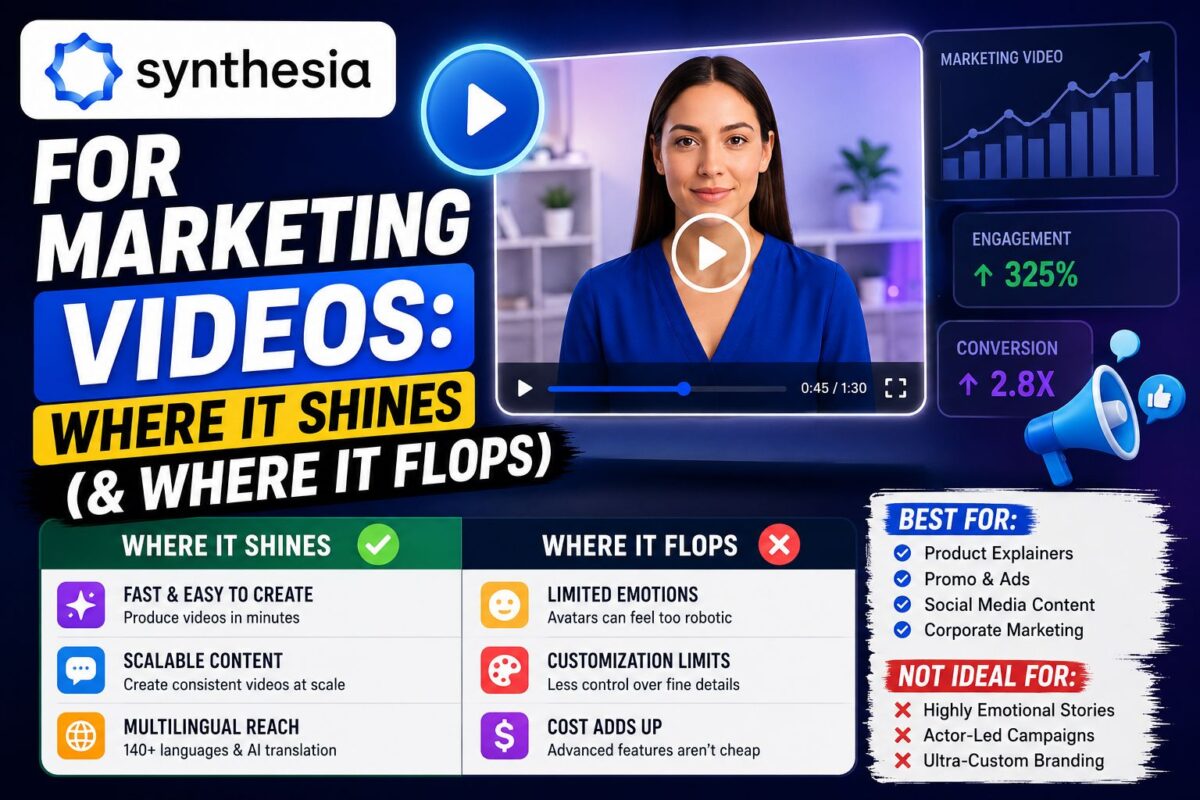
Using Synthesia for marketing videos is where the platform's biggest promise meets its hardest limit — and most reviews are too invested in the affiliate commission to tell you where the line sits.
Here it is plainly: Synthesia works for marketing content that explains, and fails for marketing content that persuades. Product demos, feature explainers, how-it-works videos — genuine fit. Paid ads, brand films, emotional storytelling — documented underperformance, including A/B tests where roughly filmed human videos beat polished AI avatars.
This post maps the boundary with the evidence, covers the 2026 updates (AI Playground changes the b-roll story), and gives you a decision framework per content type. (The complete platform evaluation, pricing and all, lives in my full Synthesia review.)
See Where It Fits Your Funnel — Free Plan, Judge With Real OutputKey Takeaways
- The explain/persuade line decides everything: informational marketing content (demos, explainers, FAQs) performs; persuasion content (ads, brand stories) underperforms because audiences detect artificial delivery.
- A marketing agency's A/B test found even poorly filmed human videos outperformed polished AI avatar ads — authenticity beats polish when the goal is conversion.
- The 2026 AI Playground (Veo 3.1 + Sora 2 b-roll) meaningfully upgrades what marketing output can look like — at 48 credits per generated clip.
- Best-fit marketing workloads: product demos with screen recording, multilingual campaign localization, and always-current evergreen explainers.
The Explain/Persuade Line: Why It Exists
Marketing video does two different jobs that get lumped together. Explaining transfers information: what the product does, how the feature works, what the offer includes. Persuading transfers emotion: trust, desire, urgency, identification.
AI avatars handle the first job well because information survives synthetic delivery intact. They fail the second because persuasion runs on authenticity signals — micro-expressions, imperfect humanity, the feeling of a real person staking their credibility — and that's precisely what current avatars can't fake.
The evidence is unusually direct. A marketing agency tested AI-generated video ads against human-recorded creatives with the goal of cutting production costs while holding performance. The result: even poorly filmed real-person videos outperformed polished AI avatar videos. Audiences detect artificial delivery immediately, and when the goal is conversion, authenticity matters more than polish. The same dynamic drives the engagement collapses documented on personality-driven channels — the full story is in my analysis of faceless YouTube videos.
The rule for marketers: the closer your video sits to the purchase decision, the worse an avatar performs.
Where Synthesia Genuinely Works in Marketing
Product Demos and Feature Explainers
This is the sweet spot. The built-in screen recorder captures your product, an avatar narrates over it, and the result looks like a well-produced SaaS demo — because it is one. Two structural advantages compound here:
- Always-current demos: when the UI changes, re-record the one affected clip and regenerate. No more demo videos showing last year's interface.
- Volume without fatigue: a demo per feature, per persona, per funnel stage becomes feasible when each costs 20 minutes instead of a production day.
Multilingual Campaign Localization
For marketing teams running campaigns across markets, the localization pipeline is the honest killer feature: one explainer, generated in every market's language with matched lip-sync, at reported cost reductions up to 80% versus traditional re-production. Campaign explainers, onboarding sequences, and knowledge-base videos localize this way exceptionally well — the mechanics and credit math are in my guide to multilingual video translation.
Middle-of-Funnel Education
Webinar-replacement content, FAQ videos, comparison explainers, onboarding email sequences — content that nurtures by informing. Viewers at this stage want answers, not charisma, and the avatar's consistency reads as professionalism.
Build a Product Demo Free — Screen Recorder Included on Every PlanThe 2026 Upgrade: AI Playground Changes the Look
The historical knock on Synthesia marketing output — an avatar floating over static brand slides — got a real answer this year. AI Playground brings Veo 3.1 and Sora 2 generation in-platform, so marketing videos can now include cinematic b-roll clips generated from prompts: product-in-context scenes, lifestyle footage, visual metaphors.
Budget for it deliberately: generated clips run 48 credits each (and prompted avatar b-roll actions cost 96), against a Creator allowance of 3,600 monthly credits. A b-roll-heavy 2-minute marketing video can quietly double its credit cost. The platform's full meter — per-minute math, overages, seat economics — is in my Synthesia pricing breakdown, and marketing teams should read it before promising stakeholders a video-per-week cadence.
Decision Framework: Content Type by Content Type
| Marketing content | Verdict | Why |
|---|---|---|
| Product demo / walkthrough | ✅ Strong fit | Screen + narration is the platform's native format |
| Feature explainer | ✅ Strong fit | Information-transfer job, avatar acceptable |
| Multilingual campaign localization | ✅ Strong fit | Category-best pipeline, 80% cost savings |
| Onboarding / nurture sequences | ✅ Good fit | Mid-funnel viewers want answers |
| FAQ and help-content video | ✅ Good fit | Always-current via script edits |
| Social organic (informational) | ⚠️ Test carefully | Platform-dependent; casual-native tools often fit better |
| Paid ads | ❌ Poor fit | A/B evidence: human video converts better |
| Brand film / storytelling | ❌ Poor fit | Emotional delivery is the one thing avatars can't do |
| Founder/personal-brand content | ❌ Poor fit | Outsourcing “you” to an avatar backfires |
One nuance on the failure rows: a custom avatar of your actual founder or spokesperson softens (but doesn't eliminate) the authenticity penalty for lightweight recurring content — think weekly product-update videos, not ad creative.
Best Practices for Marketing Teams
- Lead with the screen, not the avatar. Demo-first layouts where the product is the star and the avatar is a guide outperform avatar-first layouts in marketing contexts.
- Keep it explainer-length: 45–90 seconds for promos, under 3 minutes for demos. The format rewards density.
- Template your brand system manually. Automatic brand kits are Enterprise-gated, so build a master template with your colors, fonts, and intro/outro once, and clone it.
- Localize winners, not everything. Prove a video performs in your primary market, then spend credits multiplying it across languages.
- A/B against human video before scaling paid spend. If you must test avatars in ads, let your own conversion data — not category averages — make the call. Just budget for the likely outcome.
For the marketing jobs Synthesia handles poorly, the field has purpose-built answers — creator-oriented tools with more expressive avatars and social-native formats are ranked in my roundup of Synthesia alternatives. The strongest teams use both: Synthesia for the explain layer, humans (or better-fit tools) for the persuade layer. And if the informational side of your funnel dominates, the same production system powers internal enablement too — see how L&D teams run it in my guide to Synthesia training videos.
Test the Explainer Layer Free — Prove It on One Demo Before PayingFAQ: Synthesia for Marketing Videos
Can you use Synthesia for ads?
Technically yes, practically no. A/B testing evidence shows human-recorded video outperforming polished AI avatar ads — audiences detect artificial delivery, and conversion suffers where authenticity drives the decision.
What marketing videos is Synthesia best for?
Product demos with screen recording, feature explainers, multilingual campaign localization, onboarding sequences, and FAQ/help video — informational content where the job is explaining, not persuading.
Does Synthesia work for social media marketing?
For informational social content (tips, explainers), cautiously. For personality-driven or trend-native formats, creator-oriented tools with more expressive avatars fit better. Test per platform before committing a calendar.
Is Synthesia worth it for a marketing team?
If your funnel leans on demos, explainers, and multilingual content — yes, the production economics are compelling. If your spend concentrates in paid ads and brand storytelling, most of the platform's value won't apply to you.
The Bottom Line
The honest map has two territories: everything that explains, where the platform saves marketing teams real production budget, and everything that persuades, where the data says keep humans on camera. Respect that boundary, template your explain layer, localize what wins — and Synthesia for marketing videos earns its subscription on the half of your funnel it was actually built for.
