
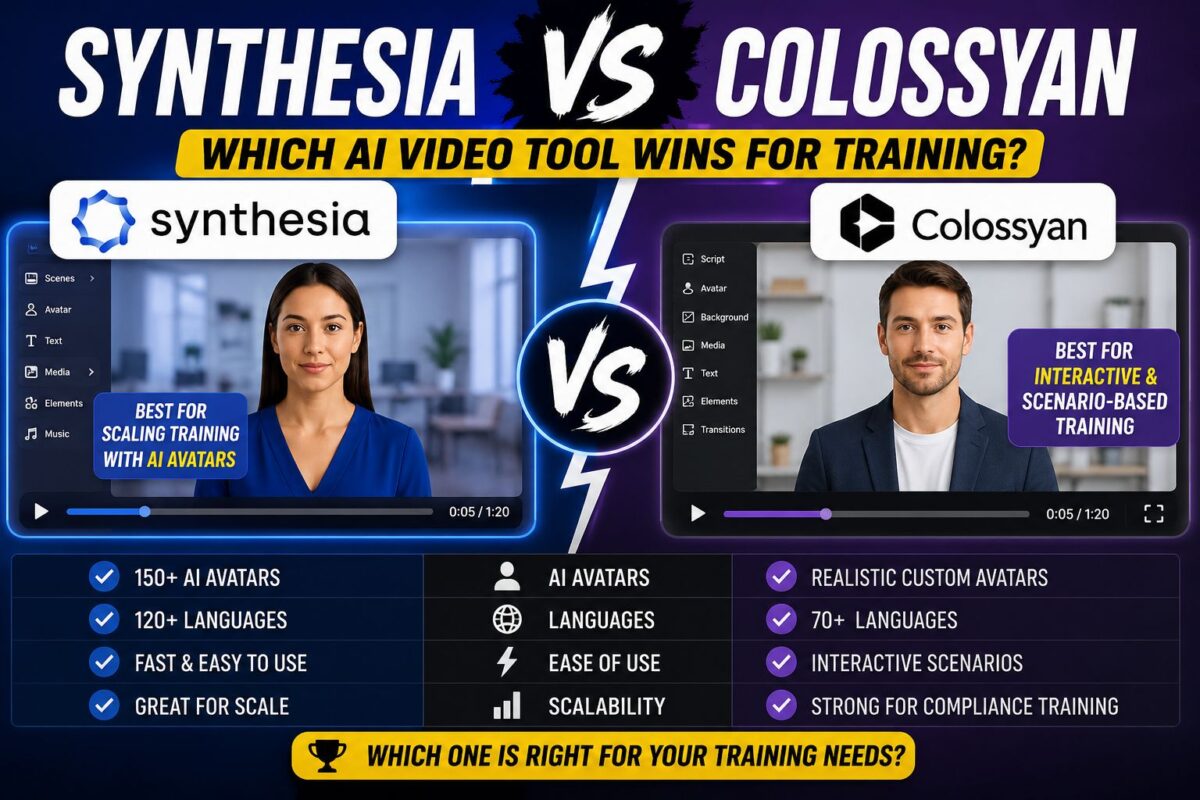
Synthesia vs Colossyan is the comparison that matters most for L&D teams, because unlike most AI video matchups, these two platforms are fighting over the exact same buyer: the training department.
The short verdict: Colossyan is the training specialist that undercuts the incumbent — multi-avatar scenes, built-in quizzes, and accessible SCORM at a lower entry price. Synthesia is the enterprise standard — bigger avatar library, deeper translation pipeline, and the compliance posture large organizations require. Team size and procurement reality decide the winner more than features do.
I've compared both on the factors that change training outcomes: avatar quality, interactive learning features, LMS integration, languages, and total cost. (For the incumbent's complete standalone evaluation, start with my full Synthesia review.)
Start the Head-to-Head Free — Synthesia's Side Costs Nothing to TestKey Takeaways
- Colossyan starts around $27–28/month and is the only platform whose avatar quality reviewers consistently rank alongside Synthesia's — with avatar emotions and aging effects Synthesia doesn't match.
- Colossyan's multi-avatar conversation scenes (up to 4 avatars in one take) enable role-play and dialogue training that Synthesia handles awkwardly.
- Synthesia wins on scale: 240+ avatars vs ~80–150, 160+ languages, the stronger translation workflow, and the deepest enterprise security stack (SOC 2, GDPR, ISO 42001).
- SCORM access is the sleeper issue: accessible on Colossyan's standard tiers, Enterprise-gated on Synthesia.
Synthesia vs Colossyan: Quick Comparison
| Factor | Synthesia | Colossyan |
|---|---|---|
| Entry price | $29/mo ($18 annual) | ~$27–28/mo |
| Stock avatars | 240+ | ~80–150 |
| Avatar emotions | Expressive avatars (script-adaptive) | Explicit emotion + aging controls |
| Multi-avatar scenes | Limited (2+ on higher tiers) | Up to 4 avatars, conversation format |
| Languages | 160+ | 60–80+ |
| Quizzes / interactivity | Creator tier and up | Built into learning workflow |
| SCORM export | Enterprise only | Accessible tiers |
| PPT/PDF-to-video | Yes, strong | Yes, strong |
| Enterprise compliance | SOC 2 II, GDPR, ISO 42001 | SOC 2, strong security posture |
| G2 rating | 4.7/5 (~2,400+ reviews) | 4.6–4.7/5 (~490 reviews) |
Avatar Quality: Closer Than Anywhere Else
In most Synthesia comparisons, avatar quality is a clear win for one side. Not here. Colossyan is widely regarded as the only platform whose avatar realism genuinely stands alongside Synthesia's — and it differentiates with capabilities the leader doesn't offer:
- Explicit emotion controls: set an avatar to deliver happily, seriously, or with concern — rather than relying on Synthesia's script-adaptive expressiveness.
- Avatar aging: present the same character at different life stages, surprisingly useful for scenario-based training.
- Conversation scenes: up to four avatars interacting in a single take.
That last one deserves emphasis. Training content lives on scenarios — manager-and-employee role plays, customer objection handling, ethics dilemmas — and dialogue between characters is Colossyan's structural advantage. Synthesia users creating dialogue videos work around the limitation; one G2 reviewer specifically wished for more two-person scenes, noting only one was available.
Synthesia counters with sheer breadth: 240+ avatars across ages, ethnicities, and presentation styles, which matters for large organizations where representation across a global workforce is a real requirement.
Winner: Colossyan for scenario-based training; Synthesia for library depth and diversity.
Compare Avatars Side by Side — Synthesia's Free Tier Takes 2 MinutesLearning Features: Colossyan's Home-Field Advantage
Colossyan built for e-learning from the start, and it shows in the workflow: quizzes and interactive knowledge checks integrate into the content pipeline, PowerPoint and PDF imports convert existing training decks directly, and the output path assumes an LMS is waiting at the end.
The LMS point is where the pricing structures diverge sharply. SCORM export — the format most learning management systems require — is accessible on Colossyan's standard tiers, while Synthesia locks it behind custom-priced Enterprise contracts. For a mid-sized training team, that single line item can force a five-figure Synthesia conversation that Colossyan handles at self-serve pricing.
Synthesia's interactivity (clickable CTAs, quizzes, branching paths, viewer scoring) is genuinely good — but it arrives at the Creator tier and matures at Enterprise. Its ChatGPT-style script assistant and the strong PowerPoint import (speaker notes become scripts automatically) keep the authoring experience competitive.
Winner: Colossyan for accessible learning infrastructure; Synthesia narrows the gap at Enterprise.
Languages and Scale: Synthesia's Counterpunch
Here the incumbent pulls decisively ahead. Synthesia's 160+ languages roughly double Colossyan's coverage, and the translation pipeline — AI dubbing with voice preservation, lip-sync matching, editable per-language versions — is the most mature localization system in the category. For a global compliance rollout in 15 languages, this isn't a feature comparison; it's the whole decision.
Synthesia also carries the heavier enterprise trust file: SOC 2 Type II, GDPR, and ISO 42001 certification, consent-verified avatar creation, and adoption the company claims across most of the Fortune 100. Procurement departments have usually already approved it — an unglamorous advantage that shortens deployments by months.
Winner: Synthesia, clearly, for multilingual and enterprise-scale programs.
Pricing: The Value Question
Entry pricing is nearly identical (~$27–29/month), so the real comparison is what each dollar buys at your production volume:
- Small training teams (1–2 creators, English-first): Colossyan delivers more training-specific capability per dollar — quizzes, conversations, SCORM — without enterprise gating.
- Volume producers: both platforms meter minutes, and both get expensive at scale. Synthesia's math ($2.90/minute, no rollover, per-seat minutes) is detailed in my Synthesia pricing breakdown; Colossyan's plans sit in a similar per-minute range.
- Enterprise: Synthesia's custom contracts (median ~$30K/year per Vendr data) buy unlimited minutes and the full feature set; Colossyan's enterprise tier is typically the cheaper quote, and worth using as negotiating leverage even if you land on Synthesia.
Which Should You Choose?
Choose Colossyan if:
- You're an L&D team of 1–5 producing scenario and dialogue-based training
- SCORM export at self-serve pricing is a requirement
- Avatar emotions and multi-character scenes fit your instructional design
- Your content is primarily in 1–3 major languages
Choose Synthesia if:
- You're localizing training across many languages — nothing else matches the pipeline
- Enterprise security review and vendor risk assessment are part of your procurement
- You need the deepest avatar library for workforce representation
- You're already in (or headed toward) an Enterprise contract where the gated features unlock
Both offer free entry points, and the deciding test costs an afternoon: build the same 90-second training module on each. If neither convinces you, the realism-focused HeyGen comparison and budget-focused D-ID comparison cover the other serious contenders, and my full roundup of Synthesia alternatives maps the entire field.
Build Your Test Module on Synthesia Free — Decide With Real OutputFAQ: Synthesia vs Colossyan
Is Colossyan cheaper than Synthesia?
At entry level they're nearly identical (~$27–29/month). The practical difference is feature access: Colossyan includes SCORM and learning features at standard tiers where Synthesia requires Enterprise contracts.
Which has better avatars, Synthesia or Colossyan?
They're the two closest platforms in the category. Colossyan adds explicit emotion controls and 4-avatar conversation scenes; Synthesia offers a far larger library (240+) with strong script-adaptive expressiveness.
Which is better for e-learning?
Colossyan for small-to-mid teams building interactive, scenario-based courses on a budget. Synthesia for enterprise programs where multilingual delivery, compliance certification, and scale dominate the requirements.
Can both convert PowerPoint to video?
Yes — both platforms convert PPT/PDF decks into avatar-narrated videos, and both handle it well. Synthesia's version retains original slide designs and converts speaker notes into scripts automatically.
The Bottom Line
This matchup splits on organizational gravity: Colossyan is the nimble specialist that gives small training teams enterprise-grade capability at self-serve prices, while Synthesia is the standard that global programs converge on once languages, compliance, and scale enter the room. Run one identical module on each free tier, weigh SCORM access against translation depth, and the Synthesia vs Colossyan decision usually makes itself by the end of the pilot.
